
“We’re too small to be targeted.”
No, you’re not. In fact, small and mid-size businesses are preferred targets.
Here’s why:
- Less security. You probably don’t have a full-time CISO or enterprise-grade firewall.
- More panic. When your data gets locked, you can’t afford weeks of downtime. You’ll pay the ransom faster than a bank would.
- Weaker backups. Many small businesses think they’re backing up but turns our they’re not or they’re backing up to the same compromised system.
Cybercriminals know this. They use automated tools that scan thousands of businesses at once and don’t care about your size. They care about your vulnerability.
Why Prevention Feels Expensive Until It’s Not
A proper backup and security setup for a small business might cost a couple thousand to a millions per year. That feels like a lot when nothing is going wrong.
However, that’s the point. Nothing is going wrong yet.
Insurance works the same way. You pay for fire insurance your whole life, hoping never to use it. Cybersecurity is insurance for your data and unlike a fire that is visible, dramatic, and rare; data loss is invisible, silent, and increasingly common.
What “Protected” Actually Means
You don’t need to become a cybersecurity expert. You need four things done right:
1. Real backups, in multiple places Not a USB drive. Not a single cloud account. The 3-2-1 rule: three copies of your data, on two different types of storage, with one copy offsite and offline. If your main system gets hit, the offline backup is untouchable.
2. Strong access controls Not “Password123.” Not the same password for everything. Multi-factor authentication (MFA) on every critical account. Limited admin access — most employees should not be able to delete everything.
3. Regular updates and patching That annoying “update available” notification? It’s often fixing a security hole that hackers already know about. Delaying updates is like leaving your door unlocked because you’re too busy to turn the key.
4. Someone watching Not a person staring at screens 24/7 (though that’s nice) but at minimum, monitoring tools that alert you to unusual activity — logins from strange locations, mass file deletions, encryption processes starting unexpectedly.
The Emotional Cost Nobody Measures
Here’s what the statistics miss: the feeling.
The nausea when you realise your data is gone. The shame of telling your team there’s no paycheck data this month. The anger at yourself for thinking “we’ll deal with security later.”
We’ve sat with business owners who’ve been through this. They don’t talk about the money first. They talk about the violation. The helplessness. The sleepless nights.
Prevention isn’t just about protecting files. It’s about protecting your peace of mind.
A Simple Test
Ask yourself honestly:
- If my main server died right now, how long until we’re operational again?
- Do I have a backup I have actually tested restoring from?
- Does everyone on my team know what a phishing email looks like?
- When did we last update our critical software?
If you hesitated on any of these, you have a gap. Gaps are where disasters happen.
You Don’t Have to Figure This Out Alone
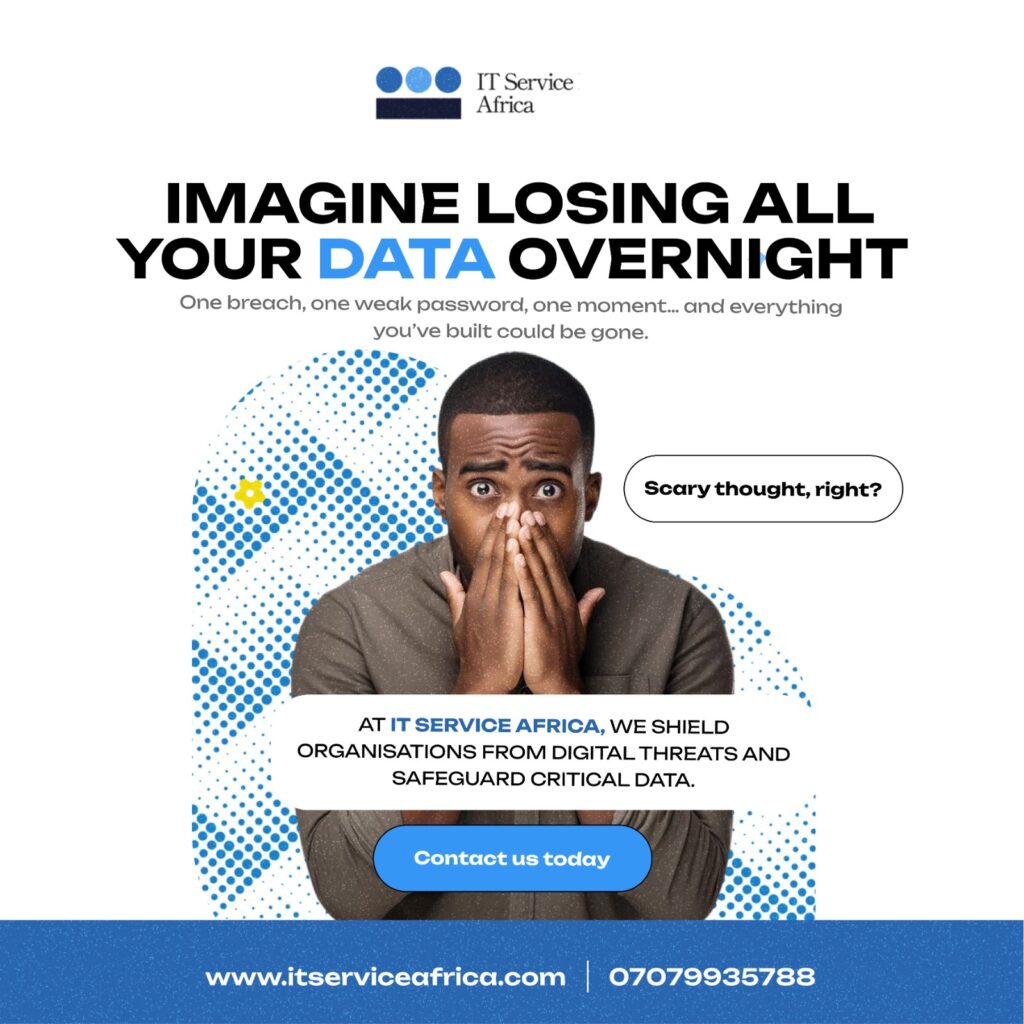
At IT Service Africa, we work with organisations across Kenya to build security that fits their size, their budget, and their actual risks. Not scare tactics. Not enterprise solutions designed for banks. Practical protection that keeps you running.
Because the worst time to think about data security is when you’re staring at a ransom note. The best time? Right now.
Don’t wait for the scary thought to become reality Contact IT Service Africa
We’ll show you where you’re strong, where you’re exposed, and what to do about it — before someone else does.
Leave a Comment