IT Service Africa

Managed Services

The Network Named “Free” That Cost Someone Everything

Blogs

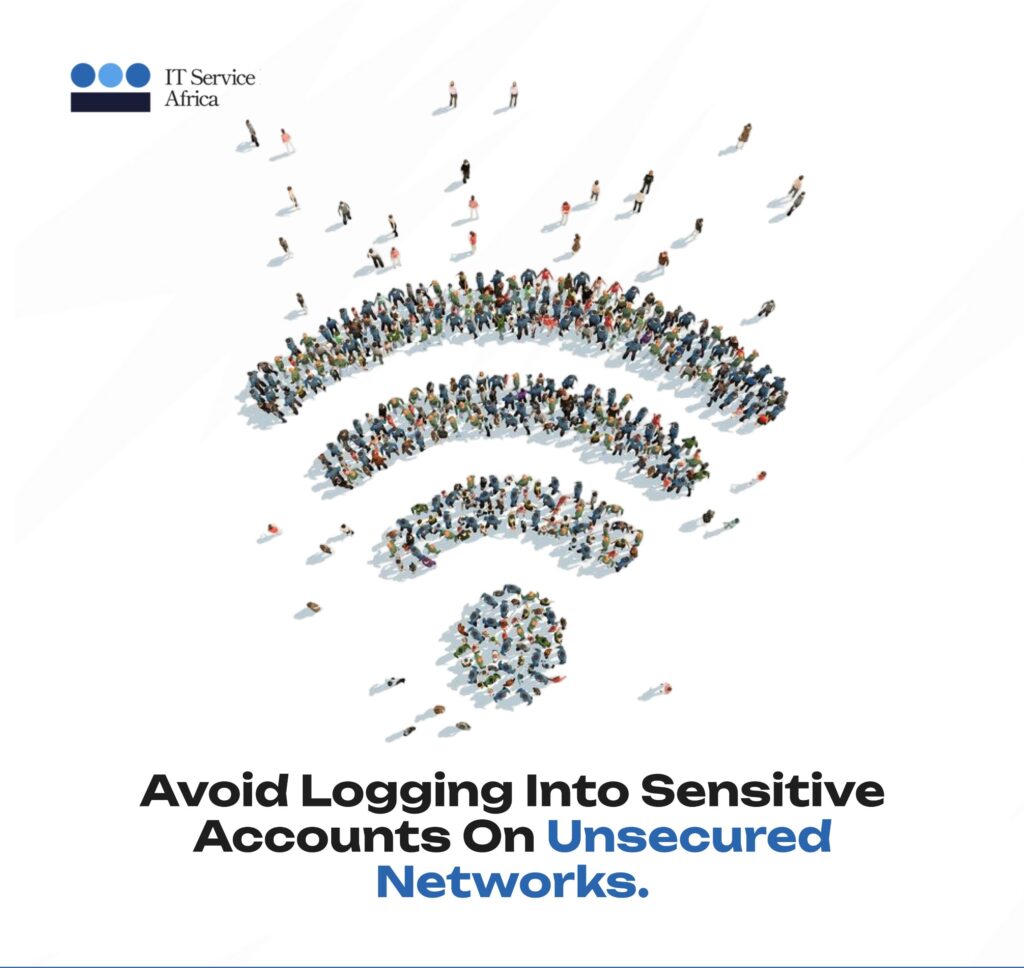
Your phone connects automatically. You open your banking app. Transfer funds to your supplier. Check your email. All normal. Free Wi-Fi does not exist. The network you joined belongs to the man three seats away with a laptop and a coffee he is not drinking. He now has your password, account balance, supplier’s details and you have fifteen minutes before your about to get on a plane, no time to notice anything wrong. This is not rare and not sophisticated. It is happening daily in Lagos, Abuja, Port Harcourt and all across the world, every crowded space where convenience overrides caution. The Math That Betrays Us Nigeria runs on mobile banking. More transactions happen through apps than branches. Mobile data is safer, encrypted by default, but it is expensive and unreliable. Therefore, we default to free Wi-Fi and weigh visible cost against invisible risk. Attackers understand this perfectly. They set up where costs pinch hardest. Name networks to sound helpful and wait for the moment trust overrides verification. One compromised login can cascade into an empty a business account, expose client data and trigger regulatory penalties destroying reputation built over years. All from one connection, we never questioned. What Verified Breaches Prove In April 2026, Adobe disclosed CVE-2026-34621. Attackers exploited a PDF vulnerability for months before discovery. Victims opened files that looked legitimate, trusted the format and the sender. The lesson is not about PDFs. It is about exploited trust. Unsecured Wi-Fi operates identically. You trust the name, the environment, that “Hotel Guest” is actually the hotel. That trust is the attack surface. Nigerian institutions face sustained pressure. The NDPC has intensified enforcement, collecting billions in penalties. The era of warnings is ending. The era of consequences has begun. Five Rules What Businesses Must Build Guest Wi-Fi must never touch internal systems. Remote workers need VPNs. Training must be continuous, not annual and detection matters as much as prevention. Most businesses discover breaches when customers complain, not when systems alert. Professional support is infrastructure, not luxury. Managed security provides monitoring and response capabilities that individual organizations cannot maintain internally. The ITSA Commitment At IT Service Africa, we design security for Nigerian realities. Unreliable power, mobile-first usage, cost sensitivity and talent scarcity. ITSA provide network security assessment, VPN deployment, endpoint protection, email filtering, continuous monitoring, evolving training, and compliance preparation. We do not sell fear. We build resilience. Your data deserves intention, not hope.

The Machine That Cried Wolf: Why Nigerian Factories Can’t Afford to Guess

Blogs

At 11:47 PM, the vibration sensor on Generator B at a Lagos manufacturing plant registered an anomaly. It was not a failure, nor was it a problem most people would notice. Just a subtle frequency shift, barely perceptible, indicating bearing degradation. AssetNova flagged it, predicted 18 days until functional failure, and auto-generated a work order. It scheduled maintenance for the following Tuesday during planned downtime and ordered replacement parts with standard delivery.  On Tuesday, technicians replaced the bearing in 90 minutes; Generator B resumed operation without interrupting production. Total cost: ₦85,000 for parts and labour. The alternative? Unplanned failure during peak production: emergency parts flown in at ten times the cost, weekend overtime for technicians, and three days of lost output valued at ₦4.2 million—plus the cascading damage to connected equipment. This is the mathematics of prediction versus reaction, and it is transforming how Nigerian industries operate. The Global Context Predictive maintenance isn’t new; aviation and oil majors have used it for decades. What’s changed is accessibility. Industrial IoT sensors became affordable, cloud computing made data storage trivial, and machine learning matured enough to detect patterns invisible to human observation. The combination means predictive maintenance now reaches mid-sized manufacturers, not just multinationals. McKinsey estimates predictive maintenance reduces equipment downtime by 30% to 50% and maintenance costs by 10% to 40%. For capital-intensive industries, this isn’t incremental improvement; it’s competitive survival. The Nigerian Specificity Nigeria’s industrial landscape creates a unique urgency. Import dependency means spare parts take weeks sometimes months to arrive. A failed bearing is not a same-day fix; it is a supply chain crisis.  Power instability accelerates equipment wear. Generators cycle more frequently and voltage fluctuations stress electrical systems. Equipment designed for stable grids degrades faster here.  Technical expertise is concentrated and mobile. The senior technician who “knows the sound” of impending failure may relocate abroad; institutional knowledge walks out the door. Capital constraints make unplanned failures existential. A major manufacturer might absorb a week’s downtime, but a growing SME might not recover Why Families Matter Here Industrial reliability is not abstract economics; it is employment stability. It means fees paid for children’s school on time and communities sustained by consistent production. When a factory avoids an unplanned shutdown, shifts continue, wages flow, and suppliers are paid. The economic ripple extends far beyond the plant gate.. Conversely, repeated equipment failures erode competitiveness. Orders move to suppliers that are more reliable. Jobs become precarious. The social contract between business and community frays.  Predictive maintenance, scaled through accessible AI, protects more than machinery; it protects livelihoods. The Psychology of Prevention Human cognition struggles with prevention: we celebrate firefighters, not fire inspectors. We fund emergency response more readily than risk reduction. This bias costs Nigerian industries billions. The maintenance budget is cut until the emergency demands multiples of what prevention would have cost; the technician’s intuition is trusted until their retirement creates a knowledge vacuum. AssetNova addresses both. It makes invisible degradation visible and converts individual intuition into institutional capability. The AI learns equipment patterns not people-dependent behaviors so knowledge persists even when technicians move on. How It Works Practically AssetNova connects to existing infrastructure—SCADA systems, PLCs, IoT sensors, historians. No rip-and-replace required. The AI engine analyzes operational data in real-time, identifying patterns that precede failure. The system then: For air-gapped or security-sensitive environments, deployment happens entirely on-premise.  For hybrid operations, cloud integration enables centralized monitoring across distributed sites. The ROI Reality Typical implementations show return within 6-8 weeks. Not through magical efficiency, but through prevented failures that would have cost multiples of the investment. A single prevented generator failure often covers annual system cost. Each subsequent prevention is pure operational advantage. More subtly, predictive maintenance changes organizational culture. Maintenance shifts from cost center to strategic function. Technicians become data-informed rather than purely experience-dependent. Planning replaces panic. Looking Ahead Nigeria’s industrial competitiveness in the next decade depends partly on policy, partly on talent, and significantly on operational reliability. The factories that thrive won’t necessarily be the newest or largest; they’ll be those that maximize existing equipment life, minimize unplanned disruption, and convert maintenance from a reactive expense to a predictive advantage. AssetNova makes this accessible not as futuristic technology, but as a practical tool. It is not going to be replacing human expertise, but extending it. The machine didn’t cry wolf; it whispered a warning. The question is whether anyone was listening. With AssetNova, someone always is.

IT Support & Managed Services in Nigeria: Keeping Things Running Behind the Scenes

Blogs

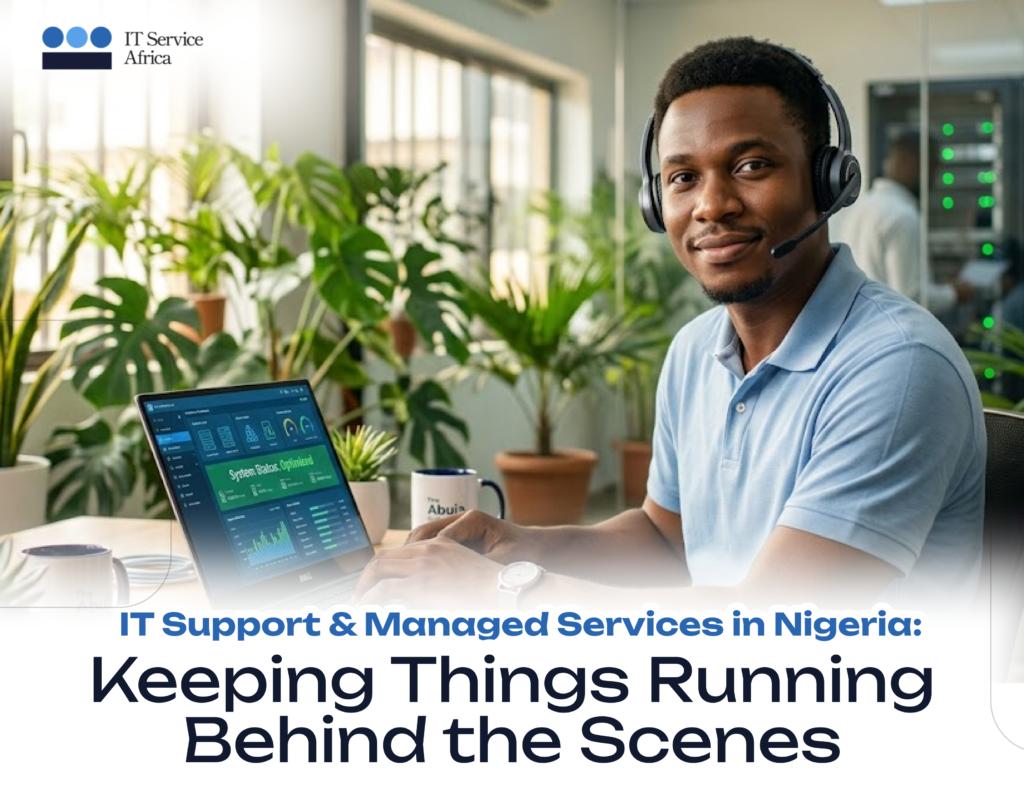
In many Nigerian businesses, technology is expected to “just work.” However, behind every smooth operation is a system that needs constant monitoring, maintenance, and support. When this support is missing, problems begin to show. The Reality of IT in Nigerian Businesses Many organizations face challenges such as: These issues may seem small, but they can affect productivity significantly. Why Managed IT Services Matter Managed services provide businesses with continuous IT support without the need for a large in-house team. Instead of waiting for problems, systems are monitored and maintained proactively. How It Impacts Businesses With proper IT support, businesses experience: i) Reduced DowntimeIssues are resolved before they escalate. ii) Improved EfficiencySystems run smoothly, allowing teams to focus on their work. iii) Better SecurityContinuous monitoring helps prevent cyber threats. How It Affects Everyday Life IT stability does not just affect businesses—it affects people. Employees work more efficiently, customers receive better service, and families relying on digital services experience fewer disruptions. The Shift toward Proactive Support The traditional approach to IT fixing problems after they occur is no longer enough. Businesses are now moving toward proactive systems that prevent issues before they happen. Conclusion In Nigeria’s fast-paced and often unpredictable environment, having reliable IT support is not a luxury—it is essential. When technology runs smoothly in the background, businesses and people can focus on what truly matters.

The Managed Services Chronicles: Part 3

Blogs, Managed Services

The Leadership View Grace, the CEO, spends her mornings focused on strategy. Expansion, new markets, and competitive advantage are her priorities. Technology isn’t her focus but she knows it can make or break growth. The Hidden Struggle She recalls past growth spurts where onboarding was chaotic and systems buckled under pressure. Leadership was dragged into troubleshooting instead of strategy. Behind the Curtain The Turning Point When the company doubled its staff, managed services absorbed the strain. Systems scaled, onboarding was smooth, and operations continued without disruption. The Payoff Grace leads boldly, knowing technology is an enabler, not a constraint. Growth is supported, not slowed down. Conclusion Through Ada, David, and Grace, we see the full spectrum of managed services: Managed services are the invisible backbone of business growth. They provide reliability, consistency, and confidence, allowing staff to stay engaged, IT to stay proactive, and leadership to stay strategic. Technology becomes not a concern, but a catalyst for success.

Disaster Recovery for Businesses: How Managed IT Saves You During Crises

Blogs, Managed Services

Imagine waking up one morning to find your servers down, your customers can’t access your services, and your data is inaccessible. Disaster recovery is what you need, not panic.  We’re all very familiar with these stories: floods, power failures, hardware crashes, cyberattacks, and so on. A single disaster can wipe out a day’s revenue, your reputation, or in worst cases, your business itself. That’s where disaster recovery comes in. And when you combine disaster recovery with managed IT services, you get a safety net that keeps your business standing. Let me walk you through what this means and show how ITSA can anchor your business during storms. What Is Disaster Recovery (DR)? In simple terms, disaster recovery is the plan and process to bring back business systems after something bad happens. This could be a fire, flood, system crash, or ransomware attack. It focuses primarily on restoring IT systems, data, and networking capabilities and ensuring you can resume operations. Fortinet explains the different types and planning of disaster recovery. Think of it like a generator. When PHCN goes off, you don’t sit in the dark; you switch to backup. Unless there is no fuel🤪or an inverter.  Disaster recovery works the same way for your business systems. Disaster recovery is a subset of business continuity. While continuity plans look at all aspects (people, operations, supply chains), DR zooms in on the tech side, getting your systems and data back online. Managed IT and Disaster Recovery  Managed IT services are when you outsource your IT needs to a specialist provider who monitors, maintains, and supports your infrastructure proactively. Add disaster recovery to that, and you get: Examples Yes, it happens These stories show what’s possible when you don’t leave your fate to chance. Key Components of a Disaster Recovery Plan A solid DR plan isn’t just a document. It’s a living system. Here are the building blocks: How Managed IT Services Bring It All Together When a managed IT provider (like ITSA) supports your disaster recovery, they do much of the heavy lifting: In short, we become your crisis insurance. Who Benefits? Let me break down who wins from a DR-backed managed IT service: What Makes a Good Disaster Recovery Plan? A disaster recovery plan doesn’t need to be complicated. Here’s what it should cover: Disasters don’t send warnings. When they strike, your systems are tested and so is your resilience. Managed IT with a rock-solid disaster recovery plan is your safety net. It doesn’t just save data, it saves your reputation, your customers and your future. Don’t wait until you’re in a crisis to think about recovery. Let’s build your disaster resilience now.

Scroll to Top