
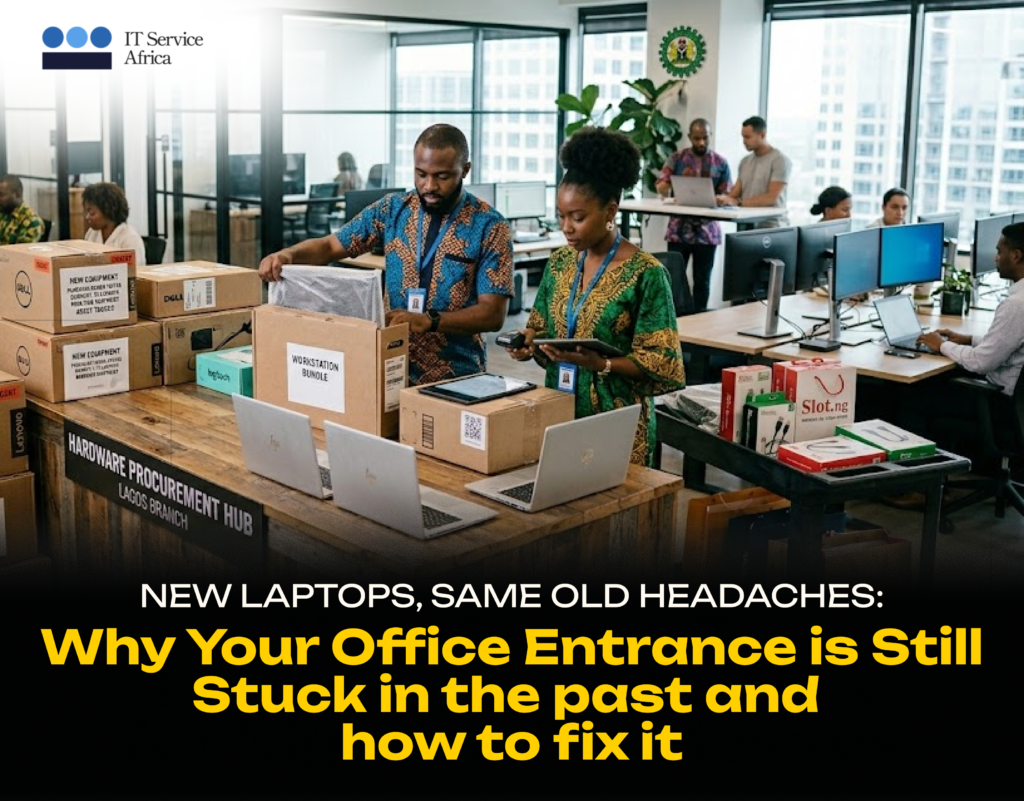
It usually starts the same way.
The business is growing. Five new staff are starting next month and they all need laptops. Someone — usually whoever is “good with computers” — is handed the task and a budget figure, and told to “sort it out.”
What happens next is familiar to almost every Nigerian business that has gone through this. A few calls are made. A few markets are visited like Computer Village, an online vendor, maybe a friend who “knows a guy.” Five laptops are bought, from two or three different sources, at three different prices, with three different warranty terms — one of which turns out to not actually be honoured when a fault appears two months later.
The new staff get their laptops. The immediate problem is solved but underneath, a slow-motion mess has begun: devices with inconsistent specifications that make IT support harder, no centralised record of what was bought, where, for how much, or under what warranty, and quietly money left on the table that a slightly more strategic approach would have kept in the business.
This happens not because anyone did anything wrong. It happens because hardware procurement, in most businesses, isn’t treated as a function. It’s treated as an errand.
Why “Just Go and Buy It” Costs More Than It Looks
You lose negotiating power. Buying five laptops one at a time, from whoever happens to have stock, means paying close to retail price every time. Buying in coordinated batches even modest ones opens the door to volume pricing, which most individual buyers never access because they’re not buying enough at once to ask for it.
Specifications drift. Without a defined standard, every purchase is a fresh decision. One person buys a laptop with 8GB of RAM because that’s what was available. The next person buys 16GB because the vendor recommended it. Two years later, your IT team is supporting a fleet of devices with no consistency, making troubleshooting, software deployment, and support significantly harder than it needs to be.
Warranty terms get lost. When devices are purchased individually from different vendors, warranty documentation tends to live in someone’s email inbox — or nowhere at all. When something goes wrong eight months later, nobody can quickly establish whether it’s still under warranty, who to contact, or what the terms were.
No asset trail from day one. A device that enters the business without being tagged, recorded, and assigned at the point of purchase is a device that’s already at risk of becoming an “unaccounted for” line item the next time someone does an asset count. (If that sounds familiar, it’s the same problem we covered in our recent posts about asset registers and audit season — and it starts here, at procurement.)
Hidden total cost of ownership. The cheapest laptop today isn’t necessarily the cheapest laptop over three years. A device that’s underpowered for its workload, that lacks proper support, or that fails early because it wasn’t built for business use ends up costing more in lost productivity, repairs, and early replacement than a slightly more expensive, properly specified device would have.
What Strategic Hardware Procurement Looks Like
At IT Service Africa, hardware procurement isn’t a one-off purchasing favor — it’s a structured process designed to get your team the right equipment, at the right price, with the right support, every time.
1. Assess Needs. Before anything is sourced, we work with you to define what’s actually required — by role, by department, by use case. A graphic designer and a data entry clerk don’t need the same laptop, and pretending otherwise either overspends on one or underdelivers on the other.
2. Source. With clear specifications defined, we leverage vendor relationships with leading OEMs — Dell, HP, Lenovo, and others — to source equipment competitively. Bulk purchase coordination and RFP support mean that even moderate order volumes can access pricing that individual purchases never could.
3. Configure. Before devices reach your team, they’re imaged with your standard software setup, configured to your security policies, and — critically — tagged as assets from day one. This is the step that makes the difference between hardware that quietly disappears into “unaccounted for” status over time, and hardware that’s part of a managed, trackable inventory from the moment it arrives. (For organisations using AssetNova, this is also the point where devices are registered into the platform, so they’re trackable for their entire lifecycle.)
4. Deliver. Logistics and onsite rollout mean your team isn’t dealing with the practical headache of receiving, unboxing, and distributing equipment across one or multiple locations.
5. Support. Warranty and maintenance arrangements are documented, centralised, and tied to a single point of contact — so when something goes wrong, the question “is this still under warranty, and who do I call” has an immediate answer.
The Real Value: Time Back
Perhaps the most underrated benefit of structured hardware procurement is simply this: nobody on your team has to “go and sort it out” anymore.
The person who used to spend two days visiting markets and comparing quotes can spend those two days doing their actual job. The new starter on Monday has a properly configured device waiting for them, not a box that arrived Friday afternoon with nothing installed. And six months from now, when someone asks “what laptops do we have, what did they cost, and are they still under warranty,” the answer is a quick lookup — not an investigation.
Let’s Sort Your Next Procurement — Properly
Whether you’re equipping five new starters or planning a full refresh across your organisation, ITSA’s hardware procurement service takes this off your plate — from specification through to delivery and ongoing support.
The right hardware, sourced properly, the first time — so you’re not sorting it out again in six months.
Leave a Comment