
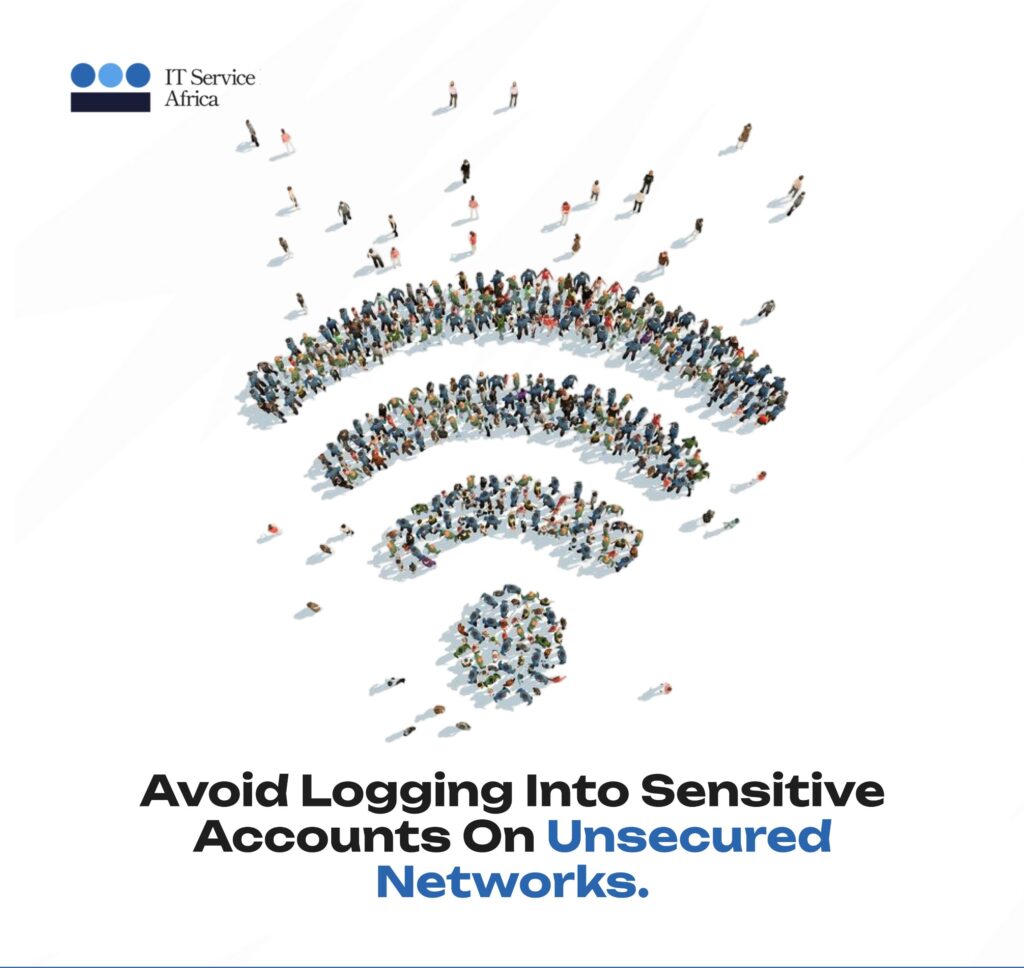
Your phone connects automatically. You open your banking app. Transfer funds to your supplier. Check your email. All normal.
Free Wi-Fi does not exist. The network you joined belongs to the man three seats away with a laptop and a coffee he is not drinking.
He now has your password, account balance, supplier’s details and you have fifteen minutes before your about to get on a plane, no time to notice anything wrong.
This is not rare and not sophisticated.
It is happening daily in Lagos, Abuja, Port Harcourt and all across the world, every crowded space where convenience overrides caution.
The Math That Betrays Us
Nigeria runs on mobile banking. More transactions happen through apps than branches. Mobile data is safer, encrypted by default, but it is expensive and unreliable.
Therefore, we default to free Wi-Fi and weigh visible cost against invisible risk.
Attackers understand this perfectly.
They set up where costs pinch hardest. Name networks to sound helpful and wait for the moment trust overrides verification.
One compromised login can cascade into an empty a business account, expose client data and trigger regulatory penalties destroying reputation built over years.
All from one connection, we never questioned.
What Verified Breaches Prove
In April 2026, Adobe disclosed CVE-2026-34621. Attackers exploited a PDF vulnerability for months before discovery. Victims opened files that looked legitimate, trusted the format and the sender.
The lesson is not about PDFs. It is about exploited trust.
Unsecured Wi-Fi operates identically. You trust the name, the environment, that “Hotel Guest” is actually the hotel. That trust is the attack surface.
Nigerian institutions face sustained pressure. The NDPC has intensified enforcement, collecting billions in penalties. The era of warnings is ending. The era of consequences has begun.
Five Rules
- Never rely on public Wi-Fi. Use mobile data.
- If you must use public Wi-Fi, use a VPN.
- Turn off auto-connect.
- Verify the network name with staff. Check for typos.
- Update everything. Phones, apps, browsers, PDF readers.
What Businesses Must Build
Guest Wi-Fi must never touch internal systems.
Remote workers need VPNs.
Training must be continuous, not annual and detection matters as much as prevention.
Most businesses discover breaches when customers complain, not when systems alert.
Professional support is infrastructure, not luxury. Managed security provides monitoring and response capabilities that individual organizations cannot maintain internally.
The ITSA Commitment
At IT Service Africa, we design security for Nigerian realities.
Unreliable power, mobile-first usage, cost sensitivity and talent scarcity.
ITSA provide network security assessment, VPN deployment, endpoint protection, email filtering, continuous monitoring, evolving training, and compliance preparation.
We do not sell fear.
We build resilience.
Your data deserves intention, not hope.
Leave a Comment