Something is happening in offices across Lagos, Abuja, and other parts of Nigeria that nobody puts on LinkedIn.
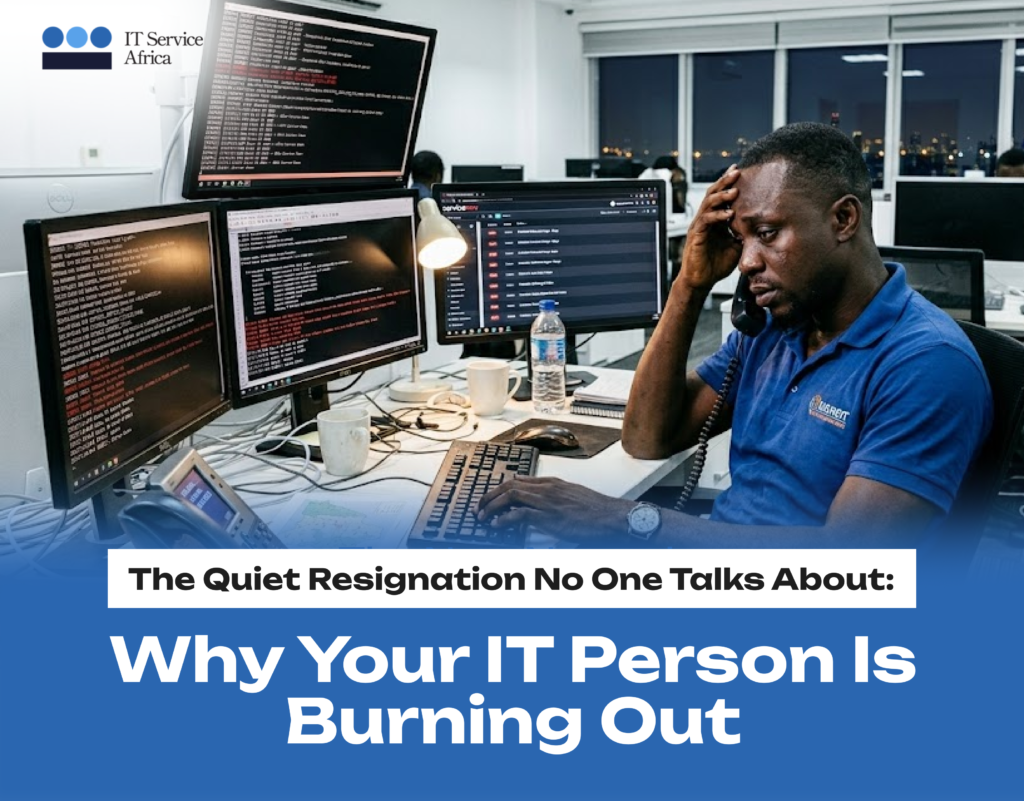
Your IT person is exhausted.
Not the dramatic, slam-the-door, send-a-scathing-email kind.
It is the quiet kind: the 2 AM alerts kind; the ‘I’ll just handle it myself’ on weekends kind; the kind that ends with them updating their CV in incognito mode while the server hums in the background.
The Global Picture
Worldwide, IT professionals are leaving the profession at record rates. A 2025 study found that 60% of IT workers report burnout.
Not stress….Burnout.
It’s the kind where competence becomes cynicism and your most reliable technical resource becomes your next recruitment headache.
The reasons are predictable: on-call demands, skill expansion without support, and the invisible load of keeping everything running while leadership sees only the monthly salary not the midnight emergencies.
The Nigerian Reality
Here, the problem compounds.
Nigeria’s tech talent competes globally. Your systems administrator in Lagos has LinkedIn messages from Dubai, London, and Toronto. Remote work erased borders so local expertise became exportable overnight.
Meanwhile, Nigerian businesses face unique pressures: unreliable power infrastructure means generator-dependent IT.
Currency volatility makes hardware planning a gamble and the expectation that “one person can handle it” persists even as technology complexity doubles every few years.
The result? Your IT person carries impossible weight and when they leave, they take institutional knowledge no handover document captures.
What Companies Lose
The direct costs are visible: recruitment fees, training time, knowledge gaps. The hidden costs hurt more. Projects stall because no one remembers why that server was configured that way, security patches slip and small issues become emergencies because the person who used to catch them early is now catching flights to their new job abroad.
A Different Model
Managed IT Services from ITSA does not replace your IT person. It protects them.
Instead of one individual carrying 24/7 responsibility, an entire team shares the load. Proactive monitoring catches issues before they become alerts. Documented processes survive personnel changes. Escalation paths mean someone is always qualified to respond, but no one person is always on call.
For your business, this means:
- Predictable monthly costs instead of surprise recruitment crises
- 24/7 coverage without 24/7 individual sacrifice
- Institutional knowledge that stays with the service, not the employee
- Scalable expertise that grows with your needs
For your IT person, it means:
- Defined working hours with genuine boundaries
- Career development instead of stagnation in generalist overwhelm
- The ability to focus on strategic projects rather than repetitive firefighting
The Real Flexibility
The global shift toward remote and hybrid work changed more than office layouts. It changed how talent thinks about employment. Nigerian professionals now evaluate opportunities differently—work-life balance is no longer a foreign concept. It is a decision factor.
Companies that ignore this lose people. Companies that address it deliberately keep them.
Managed IT Services isn’t outsourcing your technology. It’s insourcing sanity—for your team and your operations.
Looking Forward
The businesses thriving in Nigeria’s next decade won’t be those with the most heroic individual contributors. They’ll be those with the most sustainable systems.
Your IT person deserves sleep. Your business deserves continuity. Both are possible.
Leave a Comment