IT Service Africa

Uncategorized

The Most Expensive Person in Your Office Is the One Nobody Trained

Blogs, Uncategorized

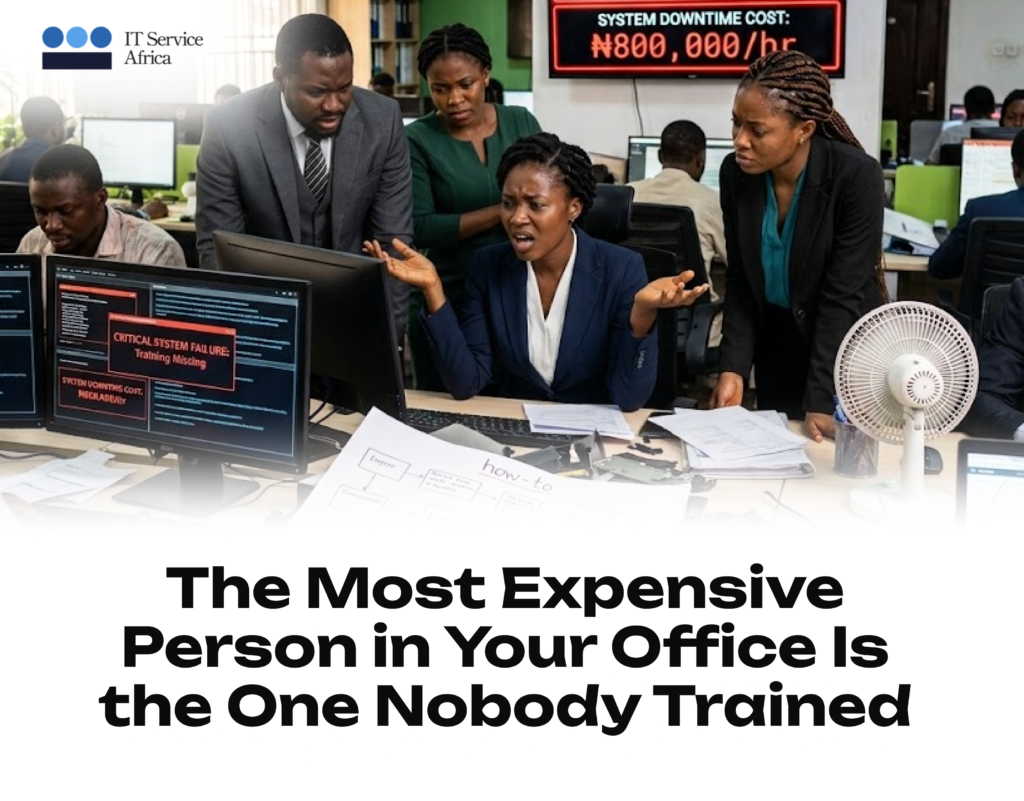
Nobody hires bad people on purpose. You hire smart, capable individuals who want to do their jobs well and then you give them technology they don’t fully understand, security responsibilities nobody explicitly explained, and software platforms they figured out mostly by trial and error. Then, when a phishing email lands in their inbox at 3pm on a busy Wednesday, and it looks exactly like it came from the MD, and it says the document is urgent — they click it.  Not because they’re careless but because nobody ever showed them what a phishing email actually looks like in practice. This is how most cyberattacks in Nigerian businesses begin. Not with sophisticated code. With a perfectly normal-looking situation that a trained person would have caught and an untrained person didn’t. The Real Cost of the Skills Gap Here’s a number worth sitting with. In a phishing simulation run across a mid-sized Nigerian organisation, 34% of staff clicked a test phishing link before any security awareness training. After a structured programme, that number dropped to under 4%. Think about what that means in practice. For every hundred people in that organisation, thirty previously clicked suspicious links without question and now fewer than four do. Every single person who didn’t click a real phishing attack because of that training is a potential incident that never happened yet. The cost of the training was a fraction of the cost of one serious incident. But the skills gap isn’t only about security. It’s about getting full value from the technology your business already has. Businesses invest significantly in IT infrastructure, cloud platforms, and enterprise systems — and then see a fraction of the potential return because the people operating them weren’t given the skills to use them properly. New tools get underused. Processes that should be efficient aren’t. Problems that a trained person would resolve quickly become recurring friction. Training isn’t a cost. It’s a multiplier on every other technology investment your organisation makes. What ITSA’s Training Covers ITSA’s training and upskilling programmes are built around the certifications and practical skills that Nigerian and African businesses actually need right now. ISO 27001 — Information Security Governance Regulators, international partners, and enterprise clients are increasingly asking for ISO 27001 certification. It’s moving from differentiator to requirement. Our programme takes your team from Foundation through Internal Auditor to Lead Implementer — building the internal capability to implement and maintain the standard, rather than perpetually paying external consultants to manage it. ITIL 4 — IT Service Management How IT services are delivered, managed, and improved inside an organisation directly affects how efficiently the whole business runs. ITIL 4 is the global framework for getting this right. Training runs from Foundation through Specialist and Managing Professional — translating directly into better IT operations, faster incident resolution, and fewer recurring problems. Cybersecurity — Essentials Through SOC Analyst From understanding what a phishing email looks like, to running a security operations function — ITSA’s cybersecurity training builds capability at every level. It turns staff from the most common entry point for attacks into an active layer of defence. Cloud Technologies — Azure and AWS Cloud adoption without cloud competence leads to overspending, underperformance, and security gaps. Our Azure and AWS tracks run from Fundamentals through to Professional level — giving your team the skills to use these platforms effectively, safely, and economically. Build the Team Your Technology Deserves Your infrastructure performs at the level of the people operating it. ITSA’s training programmes close the gap — with certifications and practical skills that stay with your team long after the course ends. Talk to us about a training programme for your organisation: Technology is only as good as the people using it. Let’s make your people exceptional.

Death to the Logbook: Why Your Office Entrance is Still Stuck in the past and how to fix it 

Uncategorized

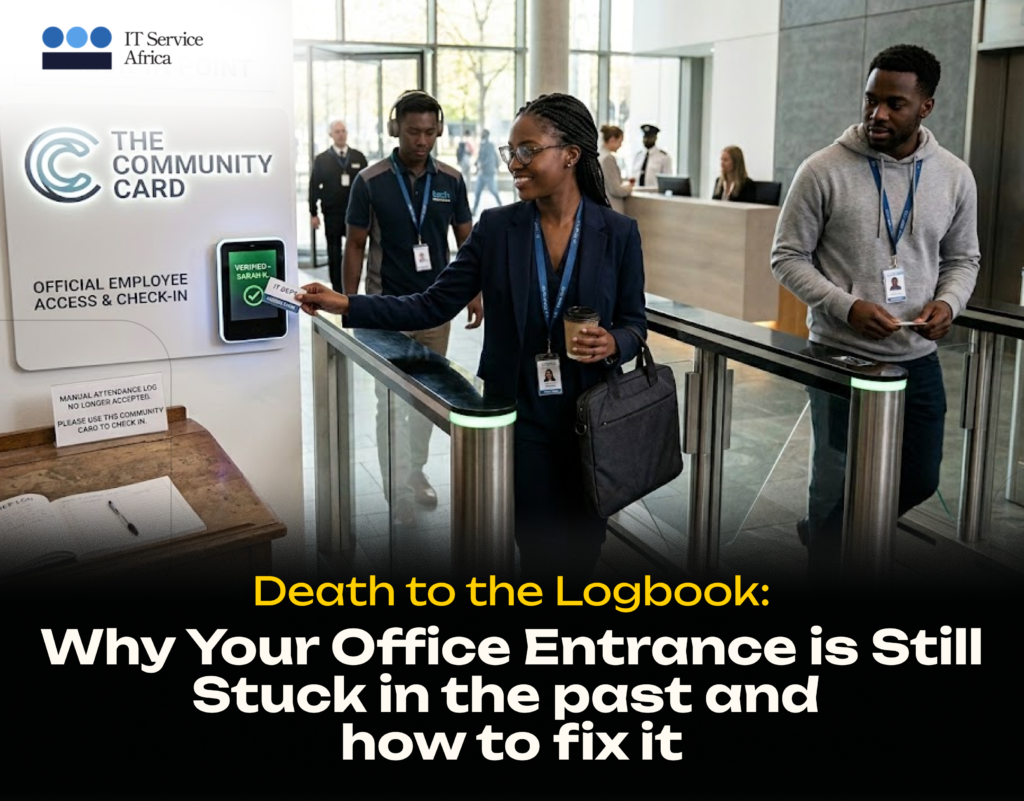
The “Sign-In” Madness  It’s 2026 and people are launching satellites and running AI-driven factories, yet if you walk into many offices in Victoria Island or Port Harcourt, you’re still greeted by a dusty, tattered logbook at the front desk.  You know the drill: everyone scribbles a fake name, an illegible phone number, and a “time-in” that is usually ten minutes off.  For a modern Nigerian enterprise, this isn’t just “old school”—it’s a massive security vulnerability and a data black hole. Enter the Community Card: The 2026 Identity Flex  At IT Service Africa (ITSA), we decided it was time to kill the logbook. Our Community Card is a unified NFC solution that transforms how you manage people, access, and security. This isn’t just a piece of plastic; it’s a digital identity token that integrates directly with your building’s turnstiles and your internal IT systems. Why Your Security Team Will Thank You The Real Impact: Curbing the Leaks  For large enterprises and public sector offices, the Community Card isn’t just about doors—it’s about curbing revenue leakages and strengthening data protection. It’s time to move your governance into the 21st century and leave the paper logbooks in the past where they belong.

The Japa-Proof Business: Why Upskilling Your Team is the Ultimate 2026 Flex

Uncategorized

The Talent Tug-of-War  Let’s be real: The “Japa” phenomenon hasn’t slowed down in 2026. Nigeria’s brightest technical minds are still in high demand globally, and for local business owners, losing a key IT lead can feel like a knockout blow.  You can try to hire your way out of the problem, but in a competitive market, the smartest strategy isn’t just finding talent—it’s building it. Internal Capability: Your Best Defense  At ITSA, we believe that a resilient business is one that owns its expertise. Our IT Training and Staff Upskilling programs are designed to turn your current workforce into a powerhouse of certified professionals.  We aren’t talking about boring PowerPoints; we provide instructor-led workshops and hands-on labs that simulate real-world technical crises. What Your Team Needs to Master Right Now  In the 2026 landscape, there are three “Gold Standards” your team should have on their CVs to keep your business running smoothly: Empowerment is the New Retention  When you invest in your team’s growth through corporate programs and certification pathways, you create loyalty. You aren’t just giving them a job; you’re giving them a career.  By empowering your staff to master the latest technologies, you ensure that your organization remains a trusted IT partner in the eyes of your clients, with a self-sustaining ecosystem of excellence that can survive any talent shift.  Stop worrying about who might leave and start focusing on how much better they’ll be while they’re here.

Happy Democracy Day : The Work Behind the Promise

Uncategorized

June 12 is a reminder, not a celebration. It reminds us that democracy is not a single event. It is the slow, daily work of building institutions that function, systems that serve, and a future that includes everyone. The promise is easy. The work is hard. It is the civil servant who shows up on time. The entrepreneur who pays employees when cash flow is tight. The teacher who prepares lessons on a slow internet connection. The engineer who stays late because something cannot fail. These are not political acts but they are democratic in the deepest sense — ordinary people using their skills to build something that serves others. Nigeria is not perfect actually, no nation is but the measure of a country is not where it stands on its best day. It is what its people do on the ordinary ones. Today, we honor the work. The patience. The belief that things can be better. And we keep building. Happy Democracy Day.

Your Biggest Cybersecurity Risk Isn’t a Hacker — It’s Your Team

Uncategorized

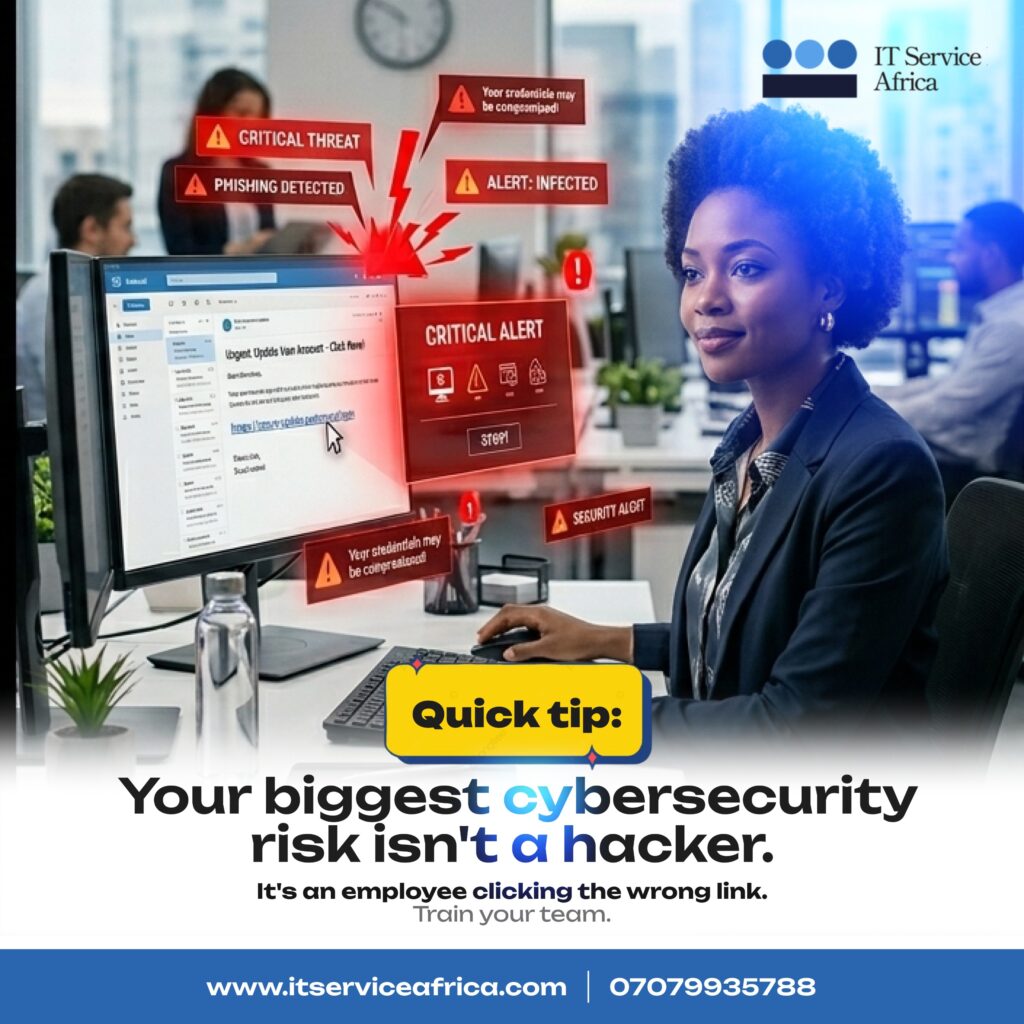
There is a painful truth in cybersecurity that nobody likes to admit. You can spend millions on firewalls, endpoint protection, and zero-trust architecture. You can hire the best engineers, deploy the most advanced threat detection, and encrypt every byte of data that enters your system. And one person on your team can undo it all with a single click. The Attack That Doesn’t Look Like an Attack We imagine breaches as dramatic. Hooded figures typing furiously, breaking through layers of encryption with genius-level code. The reality is far more boring. Most breaches start with an email. A fake invoice that looks exactly like the real ones. A message from “IT support” asking you to reset your password. A LinkedIn request from someone with a perfect profile picture and a job title that sounds familiar. A notification that says “Urgent: Update your account now” with a big blue button that begs to be pressed. These are not sophisticated technical attacks. They are psychological ones. And they work because humans are wired to be helpful, urgent, and trusting. The Verizon Data Breach Investigations Report consistently finds that roughly three out of four breaches involve the human element. Not zero-day exploits. Not advanced persistent threats. People. Clicking things they shouldn’t. Reusing passwords. Falling for scams that, in retrospect, look painfully obvious. Your firewall didn’t fail. Someone was just being human. Why the Expensive Tools Aren’t Enough Organizations love buying security tools. They show up in budgets, vendor presentations, and board reports. They feel like action. Training, on the other hand, feels like an afterthought. A compliance checkbox. A half-day seminar where half the room is checking email and the other half is wondering when lunch is. But here’s what actually happens when you skip it: In each case, the technology was fine. The human layer was not. What Good Training Actually Looks Like Real security training is not a PowerPoint presentation. It is practice. It means simulated phishing campaigns that teach people to recognize fake emails by actually receiving them in a safe environment. It means scenario-based exercises where teams walk through a breach response before the real thing happens. It means clear, simple policies that people can follow without a manual — because nobody reads the manual. At ITSA, we run practical, hands-on cybersecurity training designed for people who need to use this knowledge on Monday morning, not just pass a Friday exam. ISO 27001 for governance frameworks. CyberOps for threat awareness. Real-world simulations that make the lessons stick. The goal is not to turn every employee into a security expert. It is to make them the hardest target in your organization. Build the Layer That Matters Most True defense-in-depth includes the human layer as deliberately as the technical one. You build walls at the perimeter, gates at the network, locks at the application, and encryption at the data level. And you train the people who hold the keys. Think of it this way: the most expensive lock on your door means nothing if someone inside opens it for a stranger. Your biggest cybersecurity risk is not a hacker in a hoodie. It is the trusted employee who means well, works hard, and simply didn’t know what to look for. Train them. Support them. Make them your strength, not your vulnerability. Ready to strengthen your human firewall? At IT Service Africa, we design security awareness programs that actually change behavior — not just check boxes. From simulated phishing to certification-aligned training, we help your team become the defense layer you can rely on.

The Network Named “Free” That Cost Someone Everything

Uncategorized

Your phone connects automatically, open your banking app, transfer funds to your supplier, check your email… All normal. Free Wi-Fi does not exist. The network you joined belongs to the man three seats away with a laptop and a coffee he is not drinking. He now has your password, account balance, supplier’s details and you have fifteen minutes before your about to get on a plane, no time to notice anything wrong. This is not rare and not sophisticated.  It is happening daily in Lagos, Abuja, Port Harcourt and all across the world, every crowded space where convenience overrides caution. The Math That Betrays Us Nigeria runs on mobile banking. More transactions happen through apps than branches. Mobile data is safer, encrypted by default, but it is expensive and unreliable.  Therefore, we default to free Wi-Fi and weigh visible cost against invisible risk. Attackers understand this perfectly.  They set up where costs pinch hardest. Name networks to sound helpful and wait for the moment trust overrides verification. One compromised login can cascade into an empty a business account, expose client data and trigger regulatory penalties destroying reputation built over years. All from one connection, we never questioned. What Verified Breaches Prove In April 2026, Adobe disclosed CVE-2026-34621. Attackers exploited a PDF vulnerability for months before discovery. Victims opened files that looked legitimate, trusted the format and the sender. The lesson is not about PDFs. It is about exploited trust. Unsecured Wi-Fi operates identically. You trust the name, the environment, that “Hotel Guest” is actually the hotel. That trust is the attack surface. Nigerian institutions face sustained pressure. The NDPC has intensified enforcement, collecting billions in penalties. The era of warnings is ending. The era of consequences has begun. Five Rules What Businesses Must Build Guest Wi-Fi must never touch internal systems.  Remote workers need VPNs.  Training must be continuous, not annual and detection matters as much as prevention.  Most businesses discover breaches when customers complain, not when systems alert. Professional support is infrastructure, not luxury. Managed security provides monitoring and response capabilities that individual organizations cannot maintain internally. The ITSA Commitment At IT Service Africa, we design security for Nigerian realities.  Unreliable power, mobile-first usage, cost sensitivity and talent scarcity. We provide network security assessment, VPN deployment, endpoint protection, email filtering, continuous monitoring, evolving training, and compliance preparation. Your data deserves intention, not hope.

The World They’re Inheriting

Uncategorized

There is a child somewhere right now learning to use a tablet before they can fully read. They swipe, tap, and expect the screen to respond. They do not know about servers, firewalls, or network latency. They just know that when they press a button, something should happen. That expectation — that technology should simply work — is the world they are growing into. Moreover, it is the world we are responsible for building. More Than a Celebration Children’s Day is easy to reduce to parties and school uniforms. But the deeper question it asks is this: what kind of future are we creating for the children who will inherit everything we build today? They will not inherit our spreadsheets or our meeting notes. They will inherit the systems we put in place. The infrastructure that either works or fails them. The data policies that either protect them or expose them. The digital environments that either include them or leave them behind. When we build a secure network for a hospital, we are protecting patient records that belong to families. When we design cloud infrastructure for a school, we are creating the backbone for classrooms that will teach them. When we help a business scale responsibly, we are helping create the jobs they will one day hold. This is not abstract. It is direct. The Infrastructure of Possibility Children today are growing up in a world where artificial intelligence is normal, where remote work is expected, where digital security is as basic as physical safety. They will not remember a time before these things existed. That means the standards we set now become their baseline. If we build systems that are fragile, they will spend their adult lives fixing what we broke. If we build systems that are secure, scalable, and intuitive, we hand them something they can actually use — something they can improve upon instead of rebuild from scratch. At ITSA, this is why we take infrastructure seriously. Not because it is impressive on a slide deck, but because it is the invisible foundation that makes everything else possible. The hospital that never loses a record. The school that never drops a connection during an exam. The business that never has to tell a customer, “our systems are down.” These are not technology outcomes. They are human outcomes. What We Owe Them The children celebrating today do not need us to be perfect. They need us to be intentional. They need us to think beyond the quarterly target and consider the decade-long impact. To build security that does not just pass an audit but actually protects people. To design systems that do not just function but function well enough that no one has to think about them. They need us to build a world where technology is not a source of anxiety but a tool of possibility. Where a child can tap a screen and trust that something good will happen on the other side. ITSA is working toward that world. Not because it is easy, but because it is necessary. Happy Children’s Day to every young person in our community. May you grow up in a world that is safer, smarter, and kinder than the one we have. In addition, to every adult building that world alongside us — thank you. The work matters more than you know.

How Bespoke Software Helps Businesses Work Smarter and Grow: Part 1

Blogs, Uncategorized

When your Software Almost Works Meet Tunde. Tunde runs a growing logistics company. What started with a few deliveries a day has now expanded to multiple drivers, routes, and customers who expect real-time updates. His team uses spreadsheets, messaging apps, and a few different software tools to keep everything running. Technically… It works. But it also means drivers constantly calling for updates, spreadsheets getting overwritten, and customers waiting longer than they should for answers. The tools were not designed for the way his business actually runs. They are just tools he made work. Now meet Ada. Ada manages operations for a retail business that recently expanded online. Her team uses separate systems for inventory, orders, and accounting. Individually, the tools are great. Together, they do not communicate very well. So every week, Ada spends hours reconciling information between systems, making sure stock numbers match sales and orders. Her joke? “Half my job is fixing what the software doesn’t talk about.” Tunde and Ada share the same challenge many growing businesses face. At some point, the tools that helped you start your business stop helping you grow it. They almost work, but not quite. That is usually the moment companies start considering bespoke software systems designed specifically for how their business operates, rather than forcing the business to adapt to generic tools. And that small shift can change everything. Coming in Part 2 What actually happens when a company decides to build custom software? Is it complicated? Expensive? Worthwhile? In Part 2, we’ll follow Tunde and Ada as they explore what the journey into bespoke software really looks like. Thinking about software that actually fits your business? At IT Service Africa, we design bespoke software solutions tailored to how your organisation works, helping businesses move beyond patchwork tools to smarter, streamlined systems. Stay tuned for Part 2.

As the Year Winds Down, Your Business Shouldn’t Do Too

Uncategorized

December has a special kind of quietness…The emails slow down, meetings get lighter(less scary), and everyone starts taking stock of how far they’ve come. It’s that period of the year when people breathe a little deeper and look forward to the break, jollof rice, and fried chicken. But the truth is, while we slow down and take a break, technology doesn’t. The Systems, gadgets, and devices still need attention.Networks still have to be watched.And for cyber threats? They never take holidays. If anything, this is the season when unexpected issues like to pop up- almost like those old-school texts we used to get saying, “Congratulations! You just won an iPhone, click here to grab it!” …. A lot of us fell for that or maybe it was just me.We all knew better, but it’s a reminder that threats love catching us off guard, especially when everyone’s in a relaxed and festive mood. So December naturally brings up some important questions for any business owner: • Are our systems ready for the new year?• Do we have solid support while the office is quiet?• Are we protected during the festive period? Why Managed Services Matter This Time of Year? Good system support isn’t about drama or last-minute rescues.It’s about steady, dependable work happening quietly in the background; the kind you barely notice because everything just runs the way it should. That’s what December really needs. ✔ Systems updated and stable✔ Backups handled without interrupting operations or services✔ Active Security even when the team is offline✔ Potential issues diagnosed and fixed before they cause trouble. The goal is simple: your business should stay protected, even when everyone else is slowing down. So, as the year wraps up, this is your chance to set the tone for the year ahead. Trade Year-End Surprises for Peace of Mind. Start Now. IT Service Desk Africa

What is IT Infrastructure? A Simple Guide For Your Business

Types of IT Infrastructure
Uncategorized

In today’s marketplace, if your business doesn’t have the right IT infrastructure, you’re basically trying to run a marathon with slippers on. You’ll move, but not very far, and definitely not fast enough to compete. But wait, what exactly is IT infrastructure? And why should CEOs, SMEs, startups, and even schools pay attention to it? Let’s break it down together. What is IT Infrastructure? Think of IT infrastructure as the foundation of your digital house. It’s the mix of hardware, software, networks, and systems that keeps your business running smoothly. No infrastructure = chaos. Emails don’t send. Files don’t load. Payments don’t go through. Customers leave frustrated. Basically, your business “waka pass” without leaving an impact. At ITSA, we like to call it the digital backbone of any modern organisation. Two Main Types of IT Infrastructure Our colleague Davina explained this perfectly: Watch on LinkedIn 1. On-Prem Infrastructure (On-Premise) This is the traditional model. Your servers, switches, and computers live in your office or a physical data centre. 2. Off-Prem Infrastructure (Cloud) This is the modern model. Everything is hosted remotely on platforms like AWS, Google Cloud, or Lenovo Cloud (one of our amazing partners). The Three Pillars of Strong IT Infrastructure Whether you choose on-prem or cloud, your infrastructure is only as good as these three things: You can also learn about our IT Infrastructure Implementation Process here. Why Should Different Stakeholders Care? How ITSA Supports Businesses At ITSA, we’ve partnered with global OEMs like Lenovo, Microsoft, Cisco, and Nutanix to provide tailored IT infrastructure solutions. Whether you need cloud migration, network security, or on-prem set-up, we’ve got you covered. Because at the end of the day, Africa doesn’t lack talent or ambition; it lacks the right support systems. And ITSA is here to close that gap. Your IT infrastructure is not just cables and servers; it’s the lifeline of your business. The stronger it is, the faster and safer you can move. So, whether you’re a startup in Yaba, a bank on Victoria Island, or a university in Abuja, the question is simple: 👉🏽 Is your digital backbone strong enough for the future?

Scroll to Top