
IT Service Africa

Weekly update

Inside the Mind of a Hacker: Understanding How Cybercriminals Think

Blogs, Weekly update

When people try to imagine hackers they often picture someone in a creepy room vigorously typing on a computer trying to break into secure systems and networks. While this image is commonly used in movies, the reality of hacking is far more complicated. Cyber criminals are very strategic thinkers who carefully study their targets, exploit weaknesses or vulnerabilities and use sophisticated techniques to gain access to systems or networks. Understanding How hackers think is one of the most important steps to take in improving cybersecurity.  Who Are Hackers? Hackers are individuals with advanced technical skills who can manipulate computer systems and networks. Although not all hackers are criminals. In fact hackers are categorised into three major categories:  i) White Hat Hackers – Ethical hackers who help organizations find and fix security vulnerabilities. ii) Black Hat Hackers – Cybercriminals who exploit vulnerabilities for financial gain or malicious purposes. iii) Grey Hat Hackers – Hackers who may access systems without permission but usually do not intend to cause harm. While white hat hackers aid cybersecurity, black hat hackers focus more on exploiting systems vulnerabilities or weaknesses for profit or to damage them. How Hackers Choose Their Targets Contrary to popular belief, hackers do not always target large corporations. In many cases, they prefer smaller organizations or individuals because these targets often have weaker security defenses. Hackers typically look for: i) Poorly secured networks ii)Outdated software and systems iii) Weak passwords iv) Employees who can be manipulated through phishing or social engineering In most cyber attacks the goal is not just to have access to the system or networks but also to get human beings to be vulnerable.  Common Techniques Used by Hackers Cybercriminals depend on various methods to infiltrate systems. Some of these methods include: i)  Phishing Attacks Hackers send fake emails or messages that appear to come from trusted sources. These messages trick users into revealing sensitive information such as login credentials or financial data. ii)  Malware Attacks Malicious software can be installed on a device through infected downloads or email attachments. Once inside a system, malware can steal data, monitor activity, or damage files. iii) Password Attacks Hackers often exploit weak passwords using methods like brute-force attacks or password guessing. iv) Social Engineering Instead of hacking systems directly, attackers manipulate people into giving away confidential information. Why Hackers Do What They Do Hackers have different factors that motivate them. Which may include: i) Financial gain – stealing money or selling stolen data ii) Political or ideological motives – hacking to promote certain beliefs iii) Corporate espionage – stealing business secrets iv) Curiosity or challenge – some hackers break systems simply to prove they can Getting to understand these reasons help cybersecurity professionals anticipate potential attacks. Thinking Like a Hacker to Improve Security One of the most effective ways to defend against cyber attacks or threats is to think like the attacker. Cybersecurity professionals often use techniques such as vulnerability assessments and penetration testing to identify weaknesses before criminals can exploit them. By adopting a hacker’s mindset, organizations can better understand where their systems are vulnerable and take proactive steps to secure them. Conclusion Hackers are not just individuals randomly attacking systems they are strategic thinkers who carefully analyze their targets and exploit weaknesses. By understanding how cybercriminals think and operate, organizations and individuals can build stronger defenses against cyber threats. In cybersecurity, the key to protection is not just building stronger systems but also understanding the mindset of those trying to break them.

Data Breaches Don’t Knock, They Log In

Blogs, General Category, Managed Services, Weekly update

Most breaches don’t start with dramatic hacking scenes.They start with one weak password. One phishing email. One delayed update. And while businesses assume, “We’re probably fine,” attackers are busy automating their next attempt. A data breach today doesn’t just mean stolen files. It can mean downtime, damaged trust, regulatory questions, and expensive recovery. The real risk isn’t visibility, it’s silence. Many companies don’t even realize they’ve been compromised until weeks later. Cybersecurity isn’t about paranoia. It’s about preparation. That means: Because when something does happen, the first question won’t be ‘who attacked us’?It will be ‘were we prepared’? At ITSA, we focus on proactive cybersecurity, identifying vulnerabilities before they become incidents, strengthening your systems, and keeping your business resilient. If you’re unsure how exposed your systems are, that’s the best time to check. Let ITSA assess, secure, and strengthen your digital environment before someone else tests it for you.

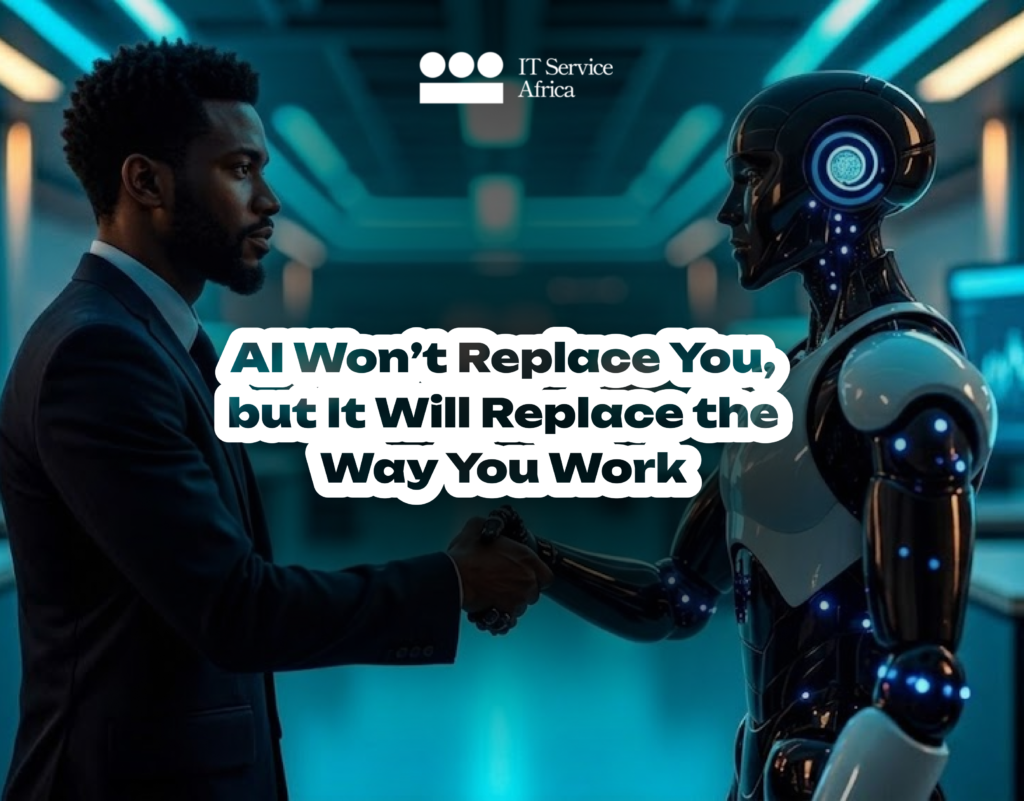
AI Won’t Replace You, But It Will Replace the Way You Work

Artificial Intelligence, Blogs, Family, Weekly update

The AI Conversation Businesses Can’t Afford to Avoid Let’s address the elephant in the boardroom:No, AI is not coming to take everyone’s jobs. But it is coming for inefficiency, wasted time, manual processes, slow reporting, poor customer response times, and guesswork decision-making. And honestly? That’s a good thing. What AI Actually Does for Businesses Think of AI as the world’s most efficient assistant. It doesn’t sleep, It doesn’t forget and It doesn’t complain about repetitive tasks. Here’s how businesses are already using it: AI handles the repetitive.Your team handles the strategic. That’s not replacement, that’s an upgrade. The Real Advantage: Better Decisions Data is everywhere. But insight?… That’s rare. AI can analyze thousands of data points in minutes and highlight patterns that would take teams weeks to uncover. That means: And here’s the slightly humorous truth:AI won’t take your job but someone using AI might. The Human Element Still Wins Creativity. Emotional intelligence. Strategy. Leadership. Relationship building. The businesses that thrive won’t be the ones resisting AI.They’ll be the ones integrating it intelligently. The Bottom Line AI is not a threat.It’s a tool. And like every powerful tool in history, the real advantage belongs to those who learn how to use it. Ready to Make AI Work for Your Business? If you’re exploring how AI can streamline operations, improve efficiency, and unlock smarter growth, now is the time to act. Let’s move from curiosity to strategy…

Tech News Update

Tech news update, Weekly update

1. Nigeria\’s Digital Renaissance: Government Drives Tech Education In a strategic move to position Nigeria as a global tech hub, the Federal Government has doubled down on initiatives aimed at empowering young Nigerians with the skills to thrive in the digital age. By investing in technology training programs and fostering a conducive environment for innovation, the government is fueling the nation\’s digital transformation. Through a variety of programs, the government is equipping young Nigerians with the necessary skills in software development, cybersecurity, artificial intelligence, and data science. These initiatives are designed to bridge the digital divide and create a skilled workforce capable of driving economic growth. The government\’s commitment to tech education is evident in its partnerships with both public and private sector organizations. By collaborating with tech giants, startups, and educational institutions, the government is leveraging expertise and resources to enhance the quality of training programs. As Nigeria continues to invest in its digital infrastructure and foster a culture of innovation, it is poised to become a leading player in the global tech scene. The government\’s focus on youth development and technology education will undoubtedly play a crucial role in shaping the country\’s future.   2. Huawei Launches Local Cloud Service in Nigeria Huawei, a global technology leader, has made a significant stride in its African expansion strategy by launching its local cloud service in Nigeria. This strategic move aims to provide enhanced data sovereignty, reduced latency, and tailored support for local businesses. By establishing a local cloud region, Huawei empowers Nigerian organizations to store and process data within the country\’s borders. This not only ensures greater data security but also accelerates application performance and improves user experience. Additionally, the local cloud service offers flexible and scalable solutions to meet the diverse needs of businesses of all sizes. Huawei\’s commitment to Nigeria is evident through its investments in local infrastructure and talent development. By offering world-class cloud services, Huawei is contributing to Nigeria\’s digital transformation and economic growth.    3. Nigerian Police Busts Fraudsters Linked to Flutterwave The Nigerian Police Force has recently arrested several individuals suspected of fraudulent activities linked to Flutterwave, a popular Nigerian fintech company. The arrests were made following an investigation into a previous security breach that resulted in significant financial losses. Law enforcement authorities are actively pursuing 601 additional suspects believed to have benefited from the proceeds of the fraudulent activities. These individuals are suspected of receiving funds from fraudulent transactions processed through Flutterwave\’s platform. This incident highlights the increasing prevalence of cybercrime and the importance of robust security measures to protect digital platforms. Both Flutterwave and Nigerian authorities are working to address the issue and ensure the safety of users\’ financial information.   4. BNI to Host Seminar on Leveraging Tech for Business Growth Business Network International (BNI) is set to host a seminar focused on the power of technology in driving business growth and global expansion. The event, themed “Leveraging Technologies for Business Growth and Global Expansion,” will take place on December 13, 2024, in Lagos.   The seminar will feature industry experts who will share insights and best practices on how businesses can harness technology to improve efficiency, increase competitiveness, and reach new markets. Attendees can expect to learn about the latest technological trends, digital marketing strategies, and cybersecurity best practices. By providing a platform for networking and knowledge sharing, BNI aims to empower businesses to thrive in the digital age. This seminar is an excellent opportunity for business owners and entrepreneurs to gain valuable insights and connect with like-minded individuals.    5. NITDA Warns of Grandoreiro Banking Malware Threat The National Information Technology Development Agency (NITDA) has issued a warning to the public about a new cybersecurity threat posed by the Grandoreiro banking malware. This sophisticated malware is capable of targeting various banking applications and stealing sensitive financial information. NITDA advises individuals to be cautious of suspicious emails, SMS messages, and phone calls, as these are often used to distribute malicious links and attachments. The agency recommends taking the following precautions to protect oneself from cyberattacks: Keep software updated: Regularly update your operating system and security software to the latest versions. Use strong, unique passwords: Avoid using weak, easily guessable passwords. Be wary of phishing attacks: Do not click on suspicious links or download attachments from unknown sources. Use reputable security software: Install and use reliable antivirus and anti-malware software. Be cautious of public Wi-Fi networks: Avoid using public Wi-Fi for sensitive online activities.   6. Moniepoint Warns Nigerians Against Sharing Account Details Mr. Babatunde Olofin, the Managing Director of Moniepoint Microfinance Bank, has issued a stern warning to Nigerians about the dangers of sharing their account details publicly, particularly during the festive season. Olofin emphasized the importance of safeguarding personal financial information to prevent cybercriminals from exploiting vulnerabilities. He urged Nigerians to be cautious and avoid sharing sensitive details on social media platforms or with strangers. The warning comes as cybercrime continues to rise, with fraudsters employing increasingly sophisticated techniques to steal personal information and financial resources. By exercising caution and avoiding sharing sensitive information, individuals can significantly reduce their risk of falling victim to cyberattacks.   7. Google\’s Pichai Forecasts a Potential AI Slowdown In a recent interview, Google CEO Sundar Pichai offered a sobering prediction about the future pace of generative AI advancements. While acknowledging the rapid strides made in the field, Pichai suggested that the industry may experience a period of consolidation and refinement in 2025. Pichai\’s assessment is rooted in the belief that many of the foundational breakthroughs in generative AI have already been achieved. As the technology matures, future advancements may be more incremental, focusing on improving the performance and efficiency of existing models. Despite this anticipated slowdown, Pichai remains optimistic about the long-term potential of AI. He emphasized the importance of responsible AI development and the need for careful consideration of the ethical implications of these powerful technologies.  As AI continues to evolve, it is crucial to strike a balance between innovation

Technology news updates

Tech news update, Weekly update

1. A Wooden Satellite Takes Flight: LignoSat Blazes a Trail A historic moment in space exploration occurred on Tuesday, November 5th, 2024, as LignoSat, the world\’s first wooden satellite, successfully launched into orbit. This groundbreaking achievement marks a significant step towards more sustainable and environmentally friendly space missions. Constructed primarily from birch wood, LignoSat is a testament to the potential of renewable materials in space technology. The satellite, developed by a team of researchers from the University of British Columbia, is designed to study the effects of radiation and extreme temperatures on wooden materials in space. The successful launch of LignoSat opens up new possibilities for future space missions. By utilizing sustainable materials, we can reduce the amount of space debris and minimize the environmental impact of space exploration. This innovative approach could revolutionize the way we design and build spacecraft, paving the way for a more sustainable future in space.   2. Apple Invests in Indonesia Amidst iPhone Ban Threat In a strategic move, Apple has announced plans to invest millions of dollars in Indonesia, a key emerging market. This comes amidst growing tensions between the tech giant and the Indonesian government over a potential ban on iPhone sales due to non-compliance with local content regulations. By increasing its investment in Indonesia, Apple aims to strengthen its position in the country and address regulatory concerns. The company is likely to focus on expanding its local manufacturing capabilities, sourcing more components from Indonesian suppliers, and investing in research and development centers. This move reflects Apple\’s commitment to complying with local regulations and fostering stronger ties with the Indonesian government. By investing in the local economy, Apple can demonstrate its dedication to Indonesia as a long-term market. However, it remains to be seen whether these efforts will be sufficient to avert a potential ban on iPhone sales in Indonesia. The situation underscores the increasing scrutiny faced by multinational companies operating in emerging markets and the importance of navigating complex regulatory landscapes. Weekly Tech News Update 3. Meta Fined $15.67 Million by South Korea\’s Data Protection Commission Meta Platforms, the parent company of Facebook, Instagram, and WhatsApp, has been fined 21.62 billion won (approximately $15.67 million) by South Korea\’s Personal Information Protection Commission. The fine was imposed for failing to comply with data protection regulations, specifically regarding the collection and processing of user data. This latest fine adds to a growing list of regulatory challenges faced by Meta globally. The company has been under intense scrutiny from regulators worldwide for its data practices, including data privacy violations and misuse of user information. The South Korean fine underscores the importance of data privacy and the significant penalties that companies can face for failing to comply with data protection regulations. As digital technologies continue to evolve, it is crucial for companies to prioritize data privacy and implement robust data protection measures.   4. Kora Launches Sundown Sessions: A Platform for African Tech Community Kora, a leading pan-African business payments infrastructure company, has launched the Kora Sundown Sessions. This series of networking events and conversations aims to bring together tech enthusiasts, industry leaders, and innovators to discuss the latest trends and opportunities in African fintech. The Sundown Sessions will provide a platform for attendees to connect with like-minded individuals, share experiences, and explore potential collaborations. The events will feature insightful discussions, panel debates, and fireside chats with industry experts. Kora\’s initiative reflects the growing importance of the African tech ecosystem. By fostering a vibrant community of innovators and entrepreneurs, Kora Sundown Sessions contribute to the development of a thriving African tech industry.   5. Microsoft Patches Critical Flaws in Windows Update Microsoft has released a critical security update to address 90 vulnerabilities in its Windows operating system. Among these vulnerabilities, two zero-day exploits have already been exploited in the wild, highlighting the urgent need for users to apply the patch. Zero-day exploits are vulnerabilities that are unknown to the software vendor and are actively being exploited by cybercriminals. These vulnerabilities can be particularly dangerous as they can be exploited before a patch is available. Microsoft\’s swift response to these vulnerabilities underscores the importance of keeping software up-to-date. Users are urged to apply the latest security updates as soon as possible to protect their systems from potential attacks. By addressing these vulnerabilities, Microsoft aims to safeguard its users from cyber threats and maintain the security of its products and services.

Weekly Tech News Update

Tech news update, Weekly update

1. Google Pours $5.8 Million into Sub-Saharan Africa\’s AI Future In a significant move to bolster Africa’s digital future, Google has announced a $5.8 million investment to accelerate AI skilling initiatives across Sub-Saharan Africa. This substantial investment underscores Google’s commitment to empowering individuals and organizations with the knowledge and tools needed to harness the power of AI. The funding will be directed towards a variety of initiatives, including: AI Training Programs: Google will offer a range of training programs, both online and offline, to equip individuals with the necessary AI skills. These programs will cover a wide range of topics, from machine learning and data science to natural language processing and computer vision. Partnerships with Universities and Organizations: Google will collaborate with leading universities and organizations across the region to develop AI curricula and research programs. By partnering with academic institutions, Google aims to foster a strong pipeline of AI talent. AI Developer Challenges and Hackathons: Google will organize AI developer challenges and hackathons to encourage innovation and problem-solving skills among young developers. These events will provide participants with an opportunity to work on real-world AI projects and network with industry experts. By investing in AI education and skills development, Google aims to create a vibrant and skilled AI workforce in Sub-Saharan Africa. This will not only drive economic growth but also help to address some of the continent’s most pressing challenges, such as poverty, disease, and climate change. This initiative aligns with Google’s broader mission to make technology accessible to everyone. By empowering individuals with AI skills, Google is helping to bridge the digital divide and create a more equitable future.   2. Nvidia\’s AI Dominance Propels it to World\’s Most Valuable Company In a historic moment, Nvidia, the tech titan renowned for its graphics processing units (GPUs), has ascended to the coveted position of the world\’s most valuable company, briefly surpassing Apple. This remarkable achievement is a testament to the company\’s pivotal role in driving the AI revolution. Nvidia\’s ascent to the top is largely attributed to the explosive growth in demand for its high-performance AI chips. These chips, particularly the H100 and A100 series, are essential for powering the development and deployment of AI applications, from natural language processing and computer vision to autonomous vehicles and drug discovery. As AI continues to reshape industries and redefine the future of technology, Nvidia\’s AI chips have become indispensable tools for researchers, developers, and businesses alike. The company\’s ability to innovate and deliver cutting-edge solutions has propelled it to the forefront of the AI revolution. This milestone not only solidifies Nvidia\’s position as a technology leader but also underscores the immense potential of AI to drive economic growth and societal progress. As AI continues to advance, it is likely that Nvidia will remain a key player in shaping the future of technology. Read the tech news update for last week. 3. Google Launches AI for Cybersecurity Program to Bolster Global Security Google has taken a significant step towards enhancing global cybersecurity by launching its AI for Cybersecurity program as part of the Google for Startup Growth Academy. This initiative aims to support innovators worldwide who are developing cutting-edge AI solutions to combat the ever-evolving cyber threats. The program offers a comprehensive suite of resources and support to help startups build and scale their cybersecurity solutions. This includes access to Google\’s advanced technologies, mentorship from industry experts, and funding opportunities. By providing these resources, Google aims to accelerate the development and deployment of innovative cybersecurity solutions. The increasing sophistication of cyberattacks poses a serious threat to individuals, businesses, and governments worldwide. AI-powered cybersecurity solutions can help organizations stay ahead of cybercriminals by automating threat detection, response, and prevention. By investing in AI for cybersecurity, Google is not only strengthening its own security posture but also contributing to the global effort to combat cyber threats. This initiative aligns with Google\’s broader mission to make the internet a safer place for everyone. As the threat landscape continues to evolve, it is crucial to foster innovation and collaboration in the cybersecurity industry. Google\’s AI for Cybersecurity program is a step in the right direction, empowering innovators to develop the next generation of cybersecurity solutions.   4. FEC Approves Creative Economy Development Fund and IP Monetization Pilot The Federal Executive Council (FEC) has taken a significant step towards boosting Nigeria’s creative economy by approving the establishment of the Creative Economy Development Fund (CEDF) and the implementation of the Intellectual Property (IP) Monetization Pilot. The CEDF is designed to provide financial support to creative industries in Nigeria, including film, music, fashion, and gaming. The fund will be used to finance projects, provide grants, and support the development of creative hubs across the country. The IP Monetization Pilot, on the other hand, is aimed at helping Nigerian creators monetize their intellectual property. This initiative will provide training, mentorship, and legal support to creators, enabling them to protect and commercialize their work. These initiatives are expected to drive innovation, create jobs, and contribute to the growth of the Nigerian economy. By supporting the creative industry, the government is recognizing its potential to drive economic development and enhance Nigeria’s global reputation.   5. Starlink Faces Stock-Out in Major Nigerian Cities Residents of Nigeria\’s major cities, Lagos, Abuja, and Port Harcourt, are facing difficulties in acquiring Starlink terminals. The popular satellite internet service provider has reportedly sold out of devices in these areas, leaving potential customers disappointed. This surge in demand for Starlink\’s high-speed internet service can be attributed to several factors, including the increasing need for reliable internet connectivity, especially in remote areas. Additionally, Starlink\’s ability to provide high-speed internet without relying on traditional infrastructure has made it an attractive option for many Nigerians. While the exact reasons for the stock-out are unclear, it is likely due to a combination of factors, such as high demand, supply chain constraints, or production limitations. Starlink has not yet provided an official statement regarding the availability of its products in Nigeria.

Weekly Tech News Update

Tech news update, Weekly update

1. Microsoft Unveils AI Tools to Streamline Healthcare Administration Microsoft has announced a new suite of AI-powered tools designed to alleviate the administrative burden faced by healthcare professionals. This initiative is part of the company\’s ongoing commitment to improving patient care and supporting doctors and nurses in their daily tasks. The new AI tools are expected to automate a variety of administrative tasks, such as scheduling appointments, managing electronic health records, and processing insurance claims. By automating these time-consuming tasks, healthcare providers can focus more on patient care and improve overall efficiency.    Microsoft\’s investment in healthcare AI is a significant step forward in leveraging technology to address the challenges faced by the healthcare industry. As AI continues to advance, we can expect to see even more innovative solutions that improve patient outcomes and streamline healthcare operations. 2. TikTok Announces Global Layoffs, Impacting Hundreds of Employees In a significant move that has sent shockwaves through the tech industry, TikTok, the popular short-form video platform owned by ByteDance, has announced layoffs affecting hundreds of employees worldwide. While the exact number of job cuts remains undisclosed, it is confirmed that a substantial portion of the layoffs will take place in Malaysia. This latest round of job cuts comes amidst a broader trend of tech companies reducing their workforce in response to economic uncertainty and changing market conditions. TikTok, which has experienced meteoric growth in recent years, is not immune to these pressures. The layoffs are expected to impact various departments within TikTok, including engineering, marketing, and content moderation. While the company has not provided specific reasons for the job cuts, it is believed that the decision was driven by a need to streamline operations and focus on core priorities. The news of the layoffs has sparked concerns about the future of TikTok and its employees. Many are worried about the potential impact on the company\’s growth and its ability to compete in the highly competitive social media landscape. Additionally, the layoffs are likely to have a significant impact on the local job market in Malaysia. As the company continues to navigate these challenging times, it remains to be seen how the layoffs will affect TikTok\’s long-term prospects. It is also unclear whether the company will implement any measures to support the affected employees during this difficult transition.   3. Federal Government Partners with Google to Train 2,500 Young Creatives In a significant boost to the creative industry in Nigeria, the Federal Government, through the Ministry of Arts, Culture, and the Creative Economy (FMACCE), has joined forces with Google to launch a training initiative aimed at empowering 2,500 young creatives across the country. The training program will equip young creatives with the skills and knowledge needed to succeed in the digital age. Participants will receive training in various areas, including digital marketing, content creation, and entrepreneurship. The initiative is designed to help young creatives monetize their talents and contribute to the growth of the Nigerian creative economy. The Federal Government and Google have expressed their commitment to scaling up the program to reach 10,000 young creatives in the future. This expansion will further strengthen the creative industry in Nigeria and create new opportunities for young people. This partnership between the Federal Government and Google is a positive step towards fostering creativity and innovation in Nigeria. By investing in the training and development of young creatives, the government is helping to create a more vibrant and dynamic creative economy. 4. Vodafone Partners with Google to Offer Advanced Cloud Services and AI Tools Vodafone Group Plc, a leading global telecommunications company, has announced a strategic 10-year partnership with Alphabet Inc.\’s Google. The partnership aims to provide Vodafone\’s customers in Africa and Europe with access to cutting-edge cloud services, generative artificial intelligence (AI) tools, and enhanced cybersecurity features. Through this collaboration, Vodafone will leverage Google Cloud\’s advanced infrastructure and AI capabilities to offer its customers a wider range of innovative solutions. This includes cloud-based services for businesses, as well as AI-powered tools for various applications. The partnership is expected to drive growth and innovation for both Vodafone and Google. By combining Vodafone\’s extensive customer base with Google\’s technological expertise, the two companies can create new opportunities and deliver enhanced value to their customers. This strategic alliance marks a significant milestone for both Vodafone and Google, as they work together to shape the future of telecommunications and technology. 5. E-commerce Fraud to Reach $107 Billion Globally by 2029 A recent study by Juniper Research has painted a concerning picture of the future of e-commerce fraud. The research firm predicts that global e-commerce fraud losses will skyrocket from $44.3 billion in 2024 to a staggering $107 billion by 2029, representing a growth of 141%. The increase in e-commerce fraud can be attributed to several factors, including the growing popularity of online shopping, the increasing sophistication of fraud techniques, and the vulnerability of e-commerce platforms to cyberattacks. The study warns that the rise in e-commerce fraud poses a significant threat to both consumers and businesses. For consumers, fraudulent transactions can lead to financial losses and identity theft. For businesses, fraud can damage their reputation, increase operational costs, and reduce customer confidence. To combat the growing threat of e-commerce fraud, businesses must invest in robust fraud prevention measures, including advanced fraud detection technologies and employee training. Additionally, consumers should be aware of the risks associated with online shopping and take steps to protect themselves from fraud.   6. Starlink Surges to 10th Largest ISP in Kenya Within a Year In a significant milestone, Starlink, the satellite internet service provider launched by SpaceX, has quickly risen to become the tenth-largest internet service provider (ISP) in Kenya just one year after its debut. According to data from Kenya\’s Communications Authority (CA), Starlink has managed to attract over 8,000 subscribers in the country since its launch. This rapid growth is a testament to the increasing demand for high-speed internet connectivity in Kenya and the appeal of Starlink\’s satellite-based solution. Starlink\’s success in

Weekly tech news update

Tech news update, Weekly update

1. Google Launches 2025 BOLD Internship Program, Inviting Applications from Underrepresented Students Google has officially opened applications for its 2025 BOLD Internship Program, a unique opportunity for talented students from underrepresented groups to gain valuable experience at one of the world\’s leading tech companies. The BOLD Internship Program provides participants with a hands-on learning experience, mentorship, and professional development opportunities. Interns will have the chance to work on real projects, collaborate with experienced Google employees, and develop their technical and leadership skills. Key Program Highlights: Paid Internship: Participants will receive a competitive salary and benefits package. Mentorship: Interns will be paired with experienced Google employees who will provide guidance and support. Professional Development: The program offers workshops, training sessions, and networking opportunities to help interns develop their skills and advance their careers. Inclusive Environment: Google is committed to creating a diverse and inclusive workplace, and the BOLD Internship Program is designed to attract and support students from underrepresented groups. Benefits for BOLD interns include: Competitive compensation and benefits Mentorship and career guidance Networking opportunities with Google employees The chance to work on cutting-edge projects To apply for the BOLD Internship Program, students must meet the following criteria: Be enrolled in a full-time undergraduate or graduate program Have a strong academic record Demonstrate leadership potential Be passionate about technology and innovation If you are a talented student from an underrepresented group and are interested in pursuing a career in technology, the Google BOLD Internship Program is an excellent opportunity to gain valuable experience and make a positive impact.   2. African Startups Flourish, Raising $138 Million in September 2024 African startups continued their impressive growth trajectory in September 2024, securing a total of $138 million in funding. This represents a significant increase compared to previous months, underscoring the growing investor confidence in the continent\’s burgeoning tech ecosystem. The funding round was a diverse mix of equity, debt, and grants, indicating the increasing maturity of the African startup landscape. While the exact breakdown of the funding is not yet publicly available, it is clear that a wide range of sectors and stages of development were represented. The $138 million raised in September 2024 marks a significant increase compared to previous months, demonstrating the growing investor interest in African startups. The funding round included equity, debt, and grants, indicating the increasing variety of financing options available to African startups. The funding was distributed across various sectors, including fintech, agritech, healthtech, and e-commerce, reflecting the diversity of the African startup ecosystem. The growing number of successful African startups is attracting larger investments from both local and international investors, fueling innovation and driving economic growth. This latest funding surge is a testament to the increasing maturity of the African startup landscape. As more and more startups achieve significant milestones, they are attracting larger investments from both local and international investors. This influx of capital is fueling innovation and driving economic growth across the continent. Kindly click here to check the tech news from last week 3. NCC Threatens Starlink with License Suspension Over Price Hike The Nigerian Communications Commission (NCC) has issued a stern warning to Starlink, a satellite internet service provider, over its recent decision to increase hardware and monthly subscription prices. The regulator has indicated that it may take \”appropriate enforcement measures,\” including the suspension of Starlink\’s operating license if the company does not comply with its directives. The NCC expressed concerns that Starlink\’s price increase was implemented without prior approval from the regulatory body. This action is seen as a violation of the terms and conditions of its operating license. The regulator has emphasized that any changes to tariffs or services must be submitted for its review and approval to ensure that they are fair and reasonable for consumers. Starlink has yet to respond publicly to the NCC\’s threat. It remains to be seen whether the company will comply with the regulator\’s demands or challenge its decision. The outcome of this dispute could have significant implications for the future of satellite internet services in Nigeria.   4. Michael Dell Sheds $1.22 Billion in Dell Technologies Shares Michael Dell, the legendary founder and CEO of Dell Technologies, has made another significant move in his personal investments. In September, Dell sold 10 million shares of the company, cashing in a substantial $1.22 billion. This marks the second major share sale by Dell in recent months, sparking speculation about his future plans. While the exact reasons behind Dell\’s decision to reduce his stake in Dell Technologies remain unclear, it could be attributed to several factors. One possibility is that he may be looking to diversify his investment portfolio and explore other opportunities. Another explanation could be that Dell is taking advantage of the current market conditions to realize some of his gains. Dell\’s sale of 10 million shares represents a significant reduction in his overall holdings in Dell Technologies. However, he still retains a substantial stake in the company, reaffirming his commitment to its long-term success. As Dell Technologies continues to navigate the evolving tech landscape, Michael Dell\’s decision to sell a portion of his shares raises questions about the company\’s future direction. It also highlights the dynamic nature of corporate ownership and the challenges faced by even the most successful entrepreneurs.   5. OpenAI Secures Massive $6.6 Billion Funding, Valued at $157 Billion In a groundbreaking move that underscores the immense potential of artificial intelligence, OpenAI, the pioneering research organization, has successfully raised a staggering $6.6 billion in new funding. This significant investment catapults the company\’s post-money valuation to a remarkable $157 billion. The infusion of capital represents a major milestone for OpenAI, solidifying its position as a dominant force in the AI landscape. This substantial funding will enable the company to accelerate its research and development efforts, potentially leading to even more groundbreaking advancements in artificial intelligence. With this new influx of funds, OpenAI can now invest more heavily in training larger and more complex AI models, expanding its research capabilities, and

Weekly tech news update

Tech news update, Weekly update

1. Mozilla Under Fire: NOYB Accuses of Secret Tracking Feature A European digital rights organization, None of Your Business (NOYB), has filed a formal complaint against Mozilla, the company behind the popular privacy-focused web browser Firefox, for quietly introducing a new tracking feature. The feature, called Privacy-Preserving Attribution (PPA), allows websites to track users across the web without their explicit consent. While Mozilla claims that PPA is designed to protect user privacy, NOYB argues that it undermines the very principles that Firefox was founded upon. According to NOYB, Mozilla rolled out the PPA feature in a recent Firefox update without informing users or obtaining their consent. The organization alleges that this constitutes a violation of European data protection laws, particularly the General Data Protection Regulation (GDPR). Mozilla has yet to issue a detailed response to NOYB\’s complaint. However, in a previous statement, the company defended the PPA feature, claiming that it is designed to protect user privacy while still allowing websites to function properly. Mozilla argues that PPA is more transparent and user-friendly than other tracking methods commonly used by websites. The controversy surrounding the PPA feature has raised concerns about the erosion of online privacy and the potential for website abuse. If NOYB\’s complaint is successful, it could have significant implications for Mozilla\’s reputation and its commitment to user privacy. The case is expected to be closely watched by privacy advocates and tech enthusiasts alike, as it could set a precedent for how companies handle user data and transparency in the digital age. 2. NCC Encourages Telecom Operators to Prioritize Talent Retention The Nigerian Communications Commission (NCC) has urged telecom operators in the country to adopt more flexible work policies, improve remuneration packages, and foster a culture of innovation to attract and retain top talent. The NCC emphasized the critical role of human capital in driving the growth and development of the telecom industry. A skilled and motivated workforce is essential for delivering quality services, meeting customer needs, and staying competitive in a rapidly evolving market. Telecom operators in Nigeria face several challenges in attracting and retaining talent. These include limited career opportunities, rigid work cultures, and inadequate compensation. The NCC believes that by addressing these issues, telecom firms can create a more attractive and rewarding work environment. The NCC\’s recommendations include: – Flexible work arrangements: Implementing flexible work options such as remote work, flexible hours, and compressed workweeks. – Competitive remuneration: Offering competitive salaries and benefits to attract and retain top talent. – Professional development opportunities: Providing opportunities for employees to learn new skills and advance their careers. – Culture of innovation: Fostering a culture that encourages creativity, experimentation, and risk- taking. By implementing these measures, telecom operators can create a more appealing work environment that attracts and retains the best talent in the industry. This, in turn, will benefit consumers by ensuring the delivery of high-quality telecom services. The NCC\’s call for improved talent management practices is a timely reminder of the importance of human capital in the telecom sector. As the industry continues to evolve, it is essential for telecom operators to invest in their employees and create a positive work environment. Boosting Nigerian Businesses With Process Automation 3. Dell Unveils AI Program to Empower Telecom Service Providers   Dell Technologies has introduced a new program, Dell AI for Telecom, designed to simplify and accelerate the adoption of artificial intelligence (AI) solutions for communications service providers (CSPs). The program was unveiled at the Dell Technologies Forum 2024, held at the Hilton Hotel Kuala Lumpur. AI is becoming increasingly important in the telecom industry, offering opportunities to improve customer experience, optimize network performance, and reduce costs. However, many CSPs face challenges in implementing AI solutions due to factors such as complexity, lack of expertise, and high costs. Dell AI for Telecom aims to address these challenges by providing CSPs with a comprehensive set of tools, resources, and support. The program includes: – Pre-configured AI solutions: Dell offers pre-configured AI solutions that can be easily deployed by CSPs. – Expert guidance: Dell provides expert guidance and support to help CSPs identify and implement the right AI solutions for their specific needs. – Partnerships: Dell collaborates with leading AI technology providers to offer a wide range of AI solutions. By leveraging Dell AI for Telecom, CSPs can more easily and quickly adopt AI technologies and realize the benefits of AI in their operations. This can include improving customer satisfaction, enhancing network efficiency, and driving new revenue streams. Dell\’s commitment to empowering telecom service providers is evident in its ongoing investments in AI and other emerging technologies. The company aims to play a leading role in helping CSPs navigate the digital transformation and succeed in the competitive telecom market. 4. Starlink\’s Aggressive Move: Lower-Cost Kit and Plan Challenge Safaricom Elon Musk\’s satellite internet service, Starlink, has intensified its competition with Safaricom in Kenya by introducing a cheaper kit and a more affordable monthly residential plan. This move comes just three days after Safaricom announced an increase in its fiber internet speeds. Starlink\’s new kit is priced lower than its previous offering, making it more accessible to a wider range of consumers. Additionally, the company has launched a $30.87 monthly residential plan, which is significantly cheaper than Safaricom\’s fiber internet options. The introduction of Starlink\’s new offerings is a clear signal of the company\’s commitment to expanding its presence in Kenya and challenging Safaricom\’s dominance in the internet market. Safaricom, one of Kenya\’s largest telecommunications companies, recently increased its fiber internet speeds to compete more effectively with Starlink. The increased competition between Starlink and Safaricom is likely to benefit Kenyan consumers, who can now choose from a wider range of internet options at more competitive prices. However, it is important to note that Starlink\’s service may have limitations, such as slower speeds and potential outages, especially in areas with limited satellite coverage. 5. Africa Tech Festival 2024: Innovators Vie for $1 Million Prize Burgeoning innovators from across the African continent

Weekly Tech News Update

Tech news update, Weekly update

1. Apple Ordered to Pay €13 Billion Tax Bill In a significant legal victory for the European Commission, the European Court of Justice (ECJ) has ruled that Apple must pay a €13 billion tax bill to Ireland. The decision upholds a 2016 European Commission ruling that found Apple had received illegal state aid from Ireland. The ECJ\’s ruling was a major blow to Apple, which had long argued that its tax arrangements with Ireland were legal. The company has maintained that it complied with all applicable tax laws and that there was no preferential treatment. However, the European Commission argued that Apple\’s tax arrangements amounted to illegal state aid, as they allowed the company to pay significantly less tax than other businesses operating in Ireland. The Commission claimed that Apple\’s tax structure gave it an unfair competitive advantage. The ECJ\’s decision is likely to have far-reaching implications for the tech industry and the concept of tax havens. It suggests that multinational corporations cannot rely on complex tax structures to avoid paying their fair share of taxes. While Apple has yet to announce its next steps, it is expected to appeal the ECJ\’s decision. The company has already indicated that it believes the ruling is flawed and that it will continue to fight for its right to pay taxes according to the law. The ECJ\’s ruling adds weight to the argument that Ireland has become a \”tax haven\” for multinational corporations. The country\’s low corporate tax rate has attracted many companies seeking to reduce their tax liabilities. However, the Apple case demonstrates that even the most sophisticated tax planning schemes can be challenged by regulators.   2. Google\’s Antitrust Fine Upheld: Implications for Online Shopping and Competition The European Union\’s (EU) highest court, the European Court of Justice (ECJ), has upheld a 2017 antitrust ruling against Google, requiring the tech giant to pay a $2.7 billion fine. The case centered on Google\’s practice of giving its shopping recommendations an unfair advantage over rival services in search results. The ECJ\’s decision is a significant victory for the EU\’s antitrust enforcement efforts. It sends a clear message to tech giants that they cannot abuse their dominant market position to stifle competition. The ruling is also likely to have a major impact on the online shopping market, as it could force Google to make changes to its search results that benefit smaller competitors. The EU Commission, which brought the case against Google, argued that the company\’s practice of prioritizing its own shopping services in search results constituted anti-competitive behavior. Google countered that its actions were justified and that it was simply providing consumers with the most relevant information. The ECJ\’s ruling rejects Google\’s arguments and finds that the company\’s actions did indeed violate EU competition law. The court\’s decision is likely to have far-reaching implications for the tech industry and the future of online shopping. It could force Google to make significant changes to its search algorithms, potentially giving smaller competitors a more level playing field. The ruling also raises questions about the future of antitrust enforcement in the digital age. As tech giants continue to grow in size and influence, there is a growing need for regulators to ensure that they do not abuse their market power. The ECJ\’s decision is a step in the right direction, but it remains to be seen whether it will be enough to curb the dominance of tech giants in the online marketplace.   3. NITDA Launches 2024 Digital Nigeria Innovation Challenge The National Information Technology Development Agency (NITDA) has officially launched the 2024 Digital Nigeria Innovation Challenge, a competition designed to harness the power of technology and innovation to tackle Nigeria\’s pressing infrastructure challenges. The challenge invites individuals and teams to develop innovative solutions that address critical infrastructure needs in areas such as transportation, energy, healthcare, education, and agriculture. The goal is to foster a culture of innovation and entrepreneurship, and to identify promising technologies that can improve the lives of Nigerians. Participants will have the opportunity to compete for substantial cash prizes and mentorship from industry experts. The winning solutions will be considered for potential implementation and scale-up. The 2024 Digital Nigeria Innovation Challenge is expected to attract a diverse range of participants from across the country, showcasing the talent and creativity of Nigerian innovators. It is anticipated that the competition will contribute to the development of a vibrant digital economy and drive sustainable growth in Nigeria.   4. OpenAI Seeks Massive Funding Round at $150 Billion Valuation OpenAI, the artificial intelligence research laboratory responsible for developing ChatGPT, is reportedly in discussions to raise a substantial $6.5 billion from investors, valuing the company at a staggering $150 billion. According to a Bloomberg report citing sources familiar with the matter, this new valuation represents a significant increase from the $86 billion valuation assigned to OpenAI earlier this year during its tender offer. If successful, the funding round would further solidify OpenAI\’s position as one of the most valuable startups globally. The influx of capital would provide OpenAI with the resources to expand its AI research and development efforts, potentially accelerating the development of even more advanced AI technologies. The company has been at the forefront of AI innovation, with ChatGPT demonstrating the immense potential of large language models in various applications. While the details of the funding round are still being negotiated, the high valuation reflects the significant market interest in OpenAI and its AI capabilities. The company\’s ability to secure such a substantial investment underscores the growing commercial potential of artificial intelligence.   5. Samsung Electronics Plans Significant Layoffs Technology giant Samsung Electronics is reportedly planning to implement substantial layoffs across its global operations, affecting up to 30% of its workforce in certain divisions. According to a Reuters report citing multiple sources familiar with the matter, the company has directed its subsidiaries worldwide to reduce their sales and marketing staff by approximately 15% and administrative staff by up to 30%. These cuts are part

Scroll to Top