They Didn’t Hack Your System: They Hacked Your Staff
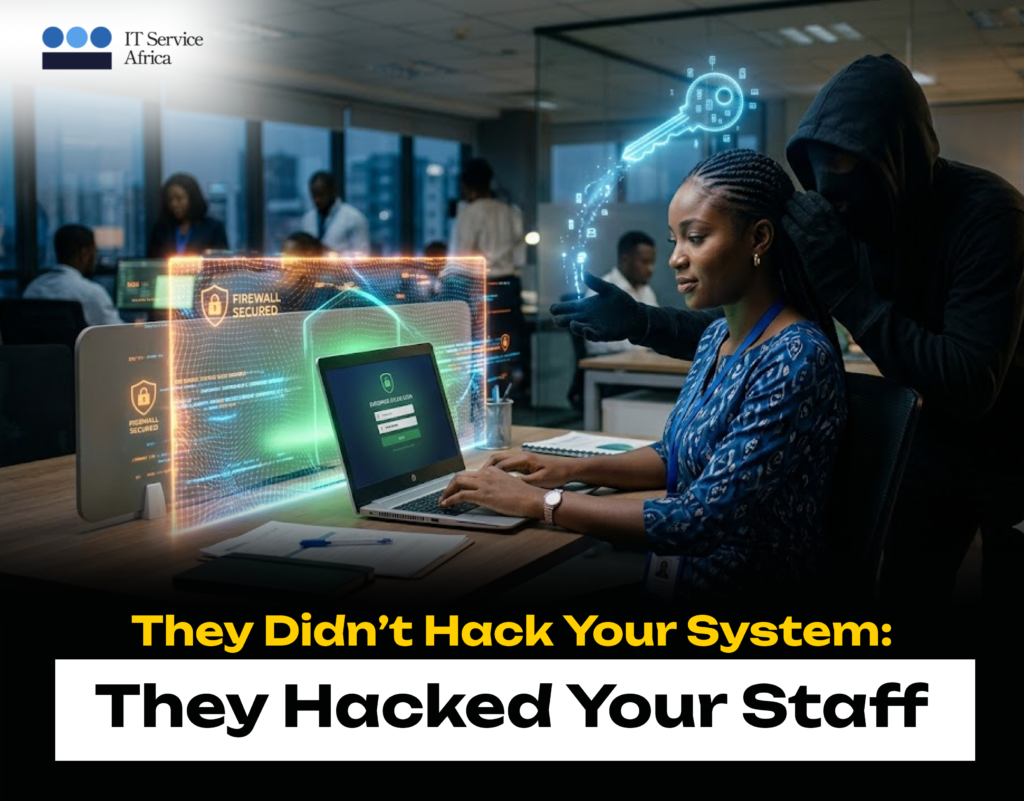
The attacker never touched a server; it took just one email, one link, and one finance officer who thought she was logging into her company’s bank portal. Three transfers left the account and nobody saw it coming because no firewall stopped it and no code triggered an alert. Someone manipulated a person in under three minutes and walked away with everything they needed. This is social engineering, and right now, it is the most common way attackers are hitting Nigerian businesses. Stop picturing a hacker in a dark room writing code. The most effective attacks today skip your systems entirely and go straight for the person at the desk. Social engineering exploits trust, urgency, fear, and the human desire to be helpful. You cannot patch those qualities out of your team, as they are what make people good at their jobs, but attackers simply know how to use them. No firewall in the world stops an employee who genuinely believes they are following a legitimate instruction. Here Is What Attackers Are Actually Doing Right Now Why Nigerian Businesses Keep Falling for This This is not a criticism of Nigerian professionals, but rather an observation about how most Nigerian organisations operate. When the MD sends an urgent message, people respond immediately. When someone calls claiming to be from the bank, the instinct is to help quickly. Similarly, when a “new IT staff member” needs access to fix something urgently, turning them away feels obstructive. Attackers study these patterns and build their entire approach around them. The speed and deference that make organisations run efficiently are the exact same qualities that social engineering turns into a weapon. Training Your People Stops This: Nothing Else Will You cannot buy a tool that fixes this problem, as no software catches every manipulated human being. What works is teaching your team to pause and to treat urgency itself as a warning sign rather than a reason to move faster. They must learn to notice when a request feels slightly off, even if they cannot immediately explain why, and feel empowered to verify without worrying about being obstructive. ITSA’s security awareness training builds these habits across your entire team through structured programmes that change real behaviour, rather than one-off sessions people forget by the end of the week. We also run simulated phishing exercises so you can see the actual numbers—how many people click, what changes after training, and where the gaps remain. One trained person can stop an attack that no firewall would have caught, while one untrained person can undo everything. Which type does your team have more of right now? Book a security awareness session for your team today. 📧 support@itserviceafrica.com