IT Service Africa

IT Support

The Network Named “Free” That Cost Someone Everything

Blogs

Your phone connects automatically. You open your banking app. Transfer funds to your supplier. Check your email. All normal. Free Wi-Fi does not exist. The network you joined belongs to the man three seats away with a laptop and a coffee he is not drinking. He now has your password, account balance, supplier’s details and you have fifteen minutes before your about to get on a plane, no time to notice anything wrong. This is not rare and not sophisticated. It is happening daily in Lagos, Abuja, Port Harcourt and all across the world, every crowded space where convenience overrides caution. The Math That Betrays Us Nigeria runs on mobile banking. More transactions happen through apps than branches. Mobile data is safer, encrypted by default, but it is expensive and unreliable. Therefore, we default to free Wi-Fi and weigh visible cost against invisible risk. Attackers understand this perfectly. They set up where costs pinch hardest. Name networks to sound helpful and wait for the moment trust overrides verification. One compromised login can cascade into an empty a business account, expose client data and trigger regulatory penalties destroying reputation built over years. All from one connection, we never questioned. What Verified Breaches Prove In April 2026, Adobe disclosed CVE-2026-34621. Attackers exploited a PDF vulnerability for months before discovery. Victims opened files that looked legitimate, trusted the format and the sender. The lesson is not about PDFs. It is about exploited trust. Unsecured Wi-Fi operates identically. You trust the name, the environment, that “Hotel Guest” is actually the hotel. That trust is the attack surface. Nigerian institutions face sustained pressure. The NDPC has intensified enforcement, collecting billions in penalties. The era of warnings is ending. The era of consequences has begun. Five Rules What Businesses Must Build Guest Wi-Fi must never touch internal systems. Remote workers need VPNs. Training must be continuous, not annual and detection matters as much as prevention. Most businesses discover breaches when customers complain, not when systems alert. Professional support is infrastructure, not luxury. Managed security provides monitoring and response capabilities that individual organizations cannot maintain internally. The ITSA Commitment At IT Service Africa, we design security for Nigerian realities. Unreliable power, mobile-first usage, cost sensitivity and talent scarcity. ITSA provide network security assessment, VPN deployment, endpoint protection, email filtering, continuous monitoring, evolving training, and compliance preparation. We do not sell fear. We build resilience. Your data deserves intention, not hope.

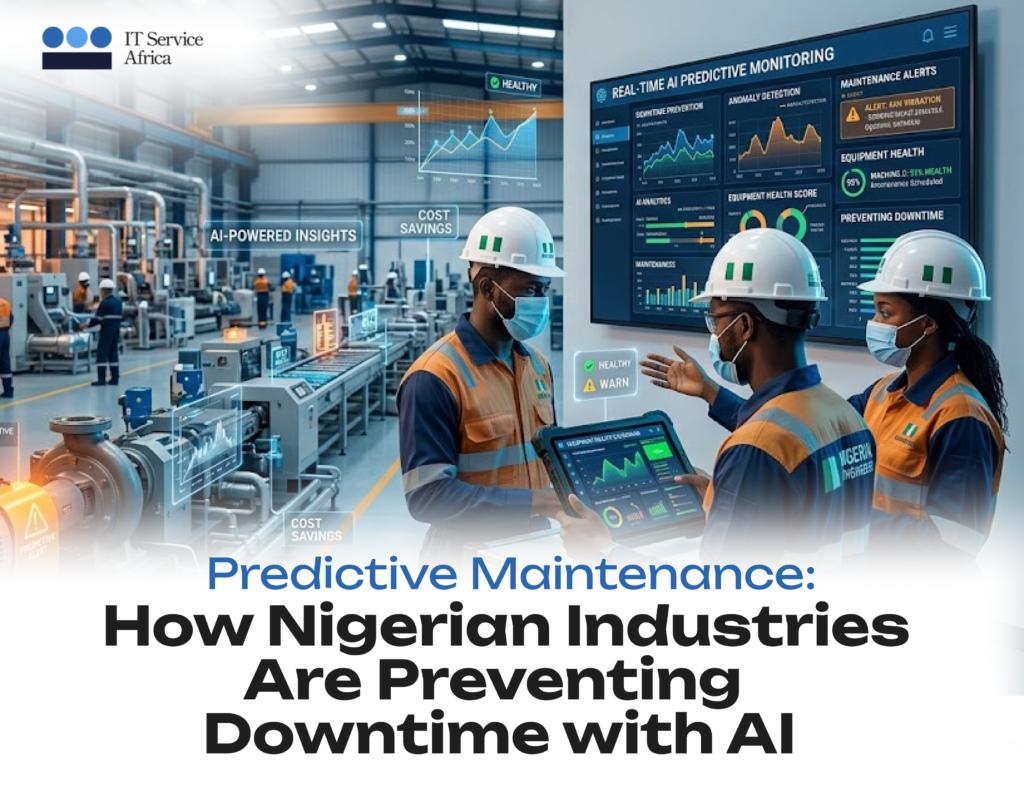
Predictive Maintenance: How Nigerian Industries Are Preventing Downtime with AI

Artificial Intelligence, Blogs, Managed Services, Tech news update

Equipment failure is expensive anywhere. In Nigeria, where supply chains are long, technical expertise is scarce, and margins are tight, unplanned downtime can be catastrophic. A single generator failure during peak production, a conveyor breakdown at a critical moment, or a pump failure at an industrial site creates costs far beyond the repair bill. AssetNova changes this equation. By predicting failures before they happen, this AI-powered platform helps Nigerian organizations shift from reactive firefighting to proactive control thereby transforming maintenance from cost center to competitive advantage. The Maintenance Challenge in Nigerian Industry Nigeria’s industrial sector faces distinctive pressures: Traditional maintenance approaches either “run until it breaks” or rigid scheduled maintenance all fail to address these realities efficiently. The True Cost of Equipment Failure When critical assets fail unexpectedly, Nigerian businesses pay multiple prices: Immediate Production Losses Every hour of stopped production is revenue lost forever. For a manufacturing line generating ₦10 million daily, a two-day outage costs ₦20 million in lost output alone. Emergency Repair Premiums Rush shipping for parts, overtime labor, and expedited service contracts multiply normal maintenance costs by 3-5x or more. Secondary Damage Initial failures often cascade damaging connected equipment, contaminating production batches, or creating safety incidents. Customer and Contract Penalties Missed delivery deadlines, broken service agreements, and damaged relationships create lasting business consequences. Regulatory and Safety Risks Equipment failures in regulated industries create compliance violations and potential liability exposure. How AssetNova Predicts and Prevents Failure AssetNova applies machine learning to equipment data transforming maintenance from calendar-based guesswork to condition-based precision: Continuous Monitoring Sensors track vibration, temperature, pressure, electrical current, and other indicators of equipment health. Data flows from SCADA systems, PLCs, IoT devices, and historians into a unified analytics platform. Pattern Recognition AI models learn normal operating patterns for each asset and then detect subtle deviations indicating developing problems. These patterns are invisible to human observation but obvious to machine intelligence. Failure Prediction Rather than vague “something might be wrong” alerts, AssetNova provides specific failure predictions with confidence intervals and time horizons—”Bearing failure likely in 14-21 days” rather than “Check bearing.” Prescriptive Action The platform automatically generates work orders, schedules maintenance crews, orders required parts, and optimizes maintenance timing to minimize production impact. Continuous Learning As more data accumulates, prediction accuracy improves. AssetNova achieves 94%+ prediction accuracy in typical deployments, with 30-40% total maintenance cost reduction. Designed for Nigerian Industrial Realities AssetNova addresses specific challenges Nigerian organizations face: Air-Gapped and Hybrid Deployment For security-sensitive operations in energy, defense, and critical infrastructure, AssetNova deploys in isolated environments without external connectivity maintaining security while delivering intelligence. Integration with Existing Infrastructure The platform connects with existing SCADA systems, historians, and control systems without requiring wholesale infrastructure replacement protecting capital investment. Support for Critical Industries Rapid ROI Typical implementations show return on investment within 6-8 weeks through prevented failures and optimized maintenance scheduling. The Transformation Journey Implementing predictive maintenance follows a structured path: Assessment Review current maintenance practices, identify critical assets, and evaluate data availability. Data Integration Connect relevant data sources—SCADA, IoT sensors, maintenance records, operational parameters. Model Training AI models learn equipment-specific patterns using historical data, refined through expert input. Pilot Validation Test predictions against actual outcomes, refine thresholds, and build organizational confidence. Scale and Optimize Expand to additional assets, integrate with maintenance management systems, and continuously improve. Building Resilient Operations For Nigerian industries, AssetNova enables: Conclusion AssetNova provides the predictive intelligence organizations need to transform maintenance from reactive cost to proactive advantage. For Nigerian manufacturers, energy operators, miners, and critical infrastructure providers, AI-powered predictive maintenance is no longer futuristic technology. It is available, proven, and essential for sustainable operations.

Managed Services: Keeping Your Business Running Smoothly

Blogs

Running a business involves constant decision-making, planning, and execution. Behind all of this is technology, quietly supporting operations every day. However, when technology fails, everything slows down. This is where managed services come in. What Are Managed Services? Managed services involve outsourcing your IT operations to a team of experts who monitor, manage, and maintain your systems. Instead of reacting to problems, managed services focus on preventing them. Why Businesses Need Managed Services Many organizations rely on internal teams or reactive IT support. While this may work temporarily, it often leads to: Managed services provide a more proactive approach. What Happens Behind the Scenes? Managed service providers handle multiple aspects of IT, including: i) System MonitoringEnsuring systems are running efficiently at all times. ii) Maintenance and UpdatesKeeping software and infrastructure up to date. iii) Security ManagementProtecting systems from cyber threats. iv) Technical SupportResolving issues quickly when they arise. Most of this happens without interrupting your daily operations. The Business Impact With managed services, businesses experience: This allows teams to focus on core business activities instead of IT concerns. Why Proactive IT Matters In today’s environment, waiting for problems to occur is no longer sustainable. Proactive IT ensures that potential issues are identified and resolved before they affect operations. Conclusion Managed services are not just about fixing problems—they are about creating stability. When your technology works consistently in the background, your business can move forward without unnecessary interruptions

How Bespoke Software Helps Businesses Work Smarter and Grow : Part 2

Blogs, General Category, Technology

Part 2: A Look Behind the Scenes of Custom Software Creation In Part 1, we met Tunde and Ada who are two business leaders dealing with systems that almost work. Eventually, both of them ask the same question many growing companies ask: “If we build custom software… where do we even start?” The answer is usually much simpler than they expect. The first step is not coding. It is a conversation. When businesses begin exploring bespoke software, the real focus is on understanding how things actually work day-to-day: where time gets lost, where systems break down, and where teams repeat the same manual tasks. This is called ‘Current State Analysis’. For Tunde, the biggest issue was not deliveries; it was communication. Drivers, dispatchers, and customers were all working with different information. For Ada, the challenge was disconnected systems. Inventory, sales, and operations were all living in different platforms. Once those challenges are clear, the next step is designing a system that fits the business, not the other way around. Sometimes that means one unified platform.Sometimes it means connecting existing systems so they work together better. This is called “System Harmonization” Either way, the goal is the same: make work simpler, faster, and easier for the people using the system every day. And the good news? Building bespoke software does not mean flipping a giant switch overnight. The process usually happens step by step, improving things gradually without disrupting the business, otherwise termed ‘Incremental Improvement’. For Tunde and Ada, that is exactly what makes the idea less intimidating. Instead of changing everything about how their teams work, the software is designed to support the processes they already know, just in a smarter way. Coming in Part 3 So what happens once the right system is finally in place? In Part 3, we’ll see how Tunde and Ada’s businesses change once their software starts working for them, not against them. And the results might surprise you… Curious about what bespoke software could do for your business… At IT Service Africa, we work closely with businesses to design software that fits their unique workflows and goals, turning complex processes into seamless systems. Stay tuned for Part 3. 

How Bespoke Software Helps Businesses Work Smarter and Grow: Part 1

Blogs, Uncategorized

When your Software Almost Works Meet Tunde. Tunde runs a growing logistics company. What started with a few deliveries a day has now expanded to multiple drivers, routes, and customers who expect real-time updates. His team uses spreadsheets, messaging apps, and a few different software tools to keep everything running. Technically… It works. But it also means drivers constantly calling for updates, spreadsheets getting overwritten, and customers waiting longer than they should for answers. The tools were not designed for the way his business actually runs. They are just tools he made work. Now meet Ada. Ada manages operations for a retail business that recently expanded online. Her team uses separate systems for inventory, orders, and accounting. Individually, the tools are great. Together, they do not communicate very well. So every week, Ada spends hours reconciling information between systems, making sure stock numbers match sales and orders. Her joke? “Half my job is fixing what the software doesn’t talk about.” Tunde and Ada share the same challenge many growing businesses face. At some point, the tools that helped you start your business stop helping you grow it. They almost work, but not quite. That is usually the moment companies start considering bespoke software systems designed specifically for how their business operates, rather than forcing the business to adapt to generic tools. And that small shift can change everything. Coming in Part 2 What actually happens when a company decides to build custom software? Is it complicated? Expensive? Worthwhile? In Part 2, we’ll follow Tunde and Ada as they explore what the journey into bespoke software really looks like. Thinking about software that actually fits your business? At IT Service Africa, we design bespoke software solutions tailored to how your organisation works, helping businesses move beyond patchwork tools to smarter, streamlined systems. Stay tuned for Part 2.

The Right IT Setup Makes Everything Easier (Here’s Why)

Blogs, Technology

When a business grows, technology quietly becomes the backbone of everything that is communication, operations, data, security, and productivity. But here’s the thing: if the IT infrastructure behind the scenes isn’t set up properly, even the best teams and tools can struggle. Slow systems, unreliable networks, and constant troubleshooting are often signs that the foundation was never built with the business in mind. That’s where thoughtful IT infrastructure setup comes in. At IT Service Africa, IT infrastructure isn’t treated as just plugging in devices and connecting cables. It’s about designing a technology environment that actually supports the way your business works. So, think of it like building a house. You wouldn’t start decorating before the structure is solid. The same goes for IT. Before software, automation, or cybersecurity can work effectively, the underlying infrastructure needs to be stable, secure, and scalable. A well-designed IT infrastructure includes everything from reliable networks and servers to secure cloud systems, structured data storage, and integrated devices. When these elements are properly designed and deployed, something interesting happens: technology stops getting in the way. Teams collaborate faster, Systems run smoothly and Data becomes easier to manage. Instead of reacting to IT problems, businesses can actually focus on growth. Another important factor is scalability. Many companies set up IT for today’s needs, but not for tomorrow’s growth. As businesses expand, their systems struggle to keep up. A good infrastructure plan anticipates that growth from the beginning, ensuring that new users, new locations, and new tools can be added without disruption. Security also plays a major role. A strong infrastructure setup ensures that networks, devices, and data are structured in a way that reduces vulnerabilities before they become risks. In simple terms, good infrastructure makes everything else work better. At IT Service Africa, our experts design and deploy IT infrastructures that are customized to the unique needs of each business. Whether it’s a new setup, an upgrade, or a complete redesign, the goal is always the same: create systems that are reliable, secure, and ready to support long-term growth. Because when the foundation is strong, everything built on top of it works better. Call to Action If your business is planning to scale, upgrade systems, or simply reduce everyday IT headaches, the right infrastructure makes all the difference.

AI Won’t Replace You, But It Will Replace the Way You Work

Artificial Intelligence, Blogs, Family, Weekly update

The AI Conversation Businesses Can’t Afford to Avoid Let’s address the elephant in the boardroom:No, AI is not coming to take everyone’s jobs. But it is coming for inefficiency, wasted time, manual processes, slow reporting, poor customer response times, and guesswork decision-making. And honestly? That’s a good thing. What AI Actually Does for Businesses Think of AI as the world’s most efficient assistant. It doesn’t sleep, It doesn’t forget and It doesn’t complain about repetitive tasks. Here’s how businesses are already using it: AI handles the repetitive.Your team handles the strategic. That’s not replacement, that’s an upgrade. The Real Advantage: Better Decisions Data is everywhere. But insight?… That’s rare. AI can analyze thousands of data points in minutes and highlight patterns that would take teams weeks to uncover. That means: And here’s the slightly humorous truth:AI won’t take your job but someone using AI might. The Human Element Still Wins Creativity. Emotional intelligence. Strategy. Leadership. Relationship building. The businesses that thrive won’t be the ones resisting AI.They’ll be the ones integrating it intelligently. The Bottom Line AI is not a threat.It’s a tool. And like every powerful tool in history, the real advantage belongs to those who learn how to use it. Ready to Make AI Work for Your Business? If you’re exploring how AI can streamline operations, improve efficiency, and unlock smarter growth, now is the time to act. Let’s move from curiosity to strategy…

From Procurement to Performance: How the Right Devices Improve Productivity

Blogs, Device Health Management Services(DHMS), Managed Services, Repair tips, Tech Solution, Technology

It usually starts off small… A laptop that takes too long to boot,a battery that never quite lasts the workday, and,a system update that breaks an important application. No one files a complaint. People just work around it. Over time, these small workarounds add up, resulting in slower tasks, missed focus, and unnecessary frustration. Productivity does not drop suddenly; it quietly leaks away. Most of the time, the root cause is not the people or the process, but the tools they are using. When devices get in the way, even simple tasks feel harder than they should. Meetings start late. Files take a longer time to load. Support requests have become routine. It is not dramatic, but it is costly. Good device procurement can change this. It begins with an understanding of how people work. Different roles have different needs, and choosing devices based on real usage, not just price, allows work to flow naturally. The right device in the right role removes friction instead of creating it. Consistency is also important. Standardized devices make setup faster, support easier, and security stronger. Employees spend less time figuring out why something works on one system and not another, and more time focused on delivering results. When devices work reliably, people stop thinking about them. They focus on their tasks, goals, and customers. This quiet reliability is what turns hardware from a recurring issue into a genuine productivity driver. At IT Service Africa, device procurement is approached with this mindset, helping businesses equip their teams with tools that support performance, security, and long-term value. Are you ready to turn your everyday devices into productivity drivers?Contact IT Service Africa to discuss procurement solutions designed for performance.

The Managed Services Chronicles: Part 3

Blogs, Managed Services

The Leadership View Grace, the CEO, spends her mornings focused on strategy. Expansion, new markets, and competitive advantage are her priorities. Technology isn’t her focus but she knows it can make or break growth. The Hidden Struggle She recalls past growth spurts where onboarding was chaotic and systems buckled under pressure. Leadership was dragged into troubleshooting instead of strategy. Behind the Curtain The Turning Point When the company doubled its staff, managed services absorbed the strain. Systems scaled, onboarding was smooth, and operations continued without disruption. The Payoff Grace leads boldly, knowing technology is an enabler, not a constraint. Growth is supported, not slowed down. Conclusion Through Ada, David, and Grace, we see the full spectrum of managed services: Managed services are the invisible backbone of business growth. They provide reliability, consistency, and confidence, allowing staff to stay engaged, IT to stay proactive, and leadership to stay strategic. Technology becomes not a concern, but a catalyst for success.

Disaster Recovery for Businesses: How Managed IT Saves You During Crises

Blogs, Managed Services

Imagine waking up one morning to find your servers down, your customers can’t access your services, and your data is inaccessible. Disaster recovery is what you need, not panic.  We’re all very familiar with these stories: floods, power failures, hardware crashes, cyberattacks, and so on. A single disaster can wipe out a day’s revenue, your reputation, or in worst cases, your business itself. That’s where disaster recovery comes in. And when you combine disaster recovery with managed IT services, you get a safety net that keeps your business standing. Let me walk you through what this means and show how ITSA can anchor your business during storms. What Is Disaster Recovery (DR)? In simple terms, disaster recovery is the plan and process to bring back business systems after something bad happens. This could be a fire, flood, system crash, or ransomware attack. It focuses primarily on restoring IT systems, data, and networking capabilities and ensuring you can resume operations. Fortinet explains the different types and planning of disaster recovery. Think of it like a generator. When PHCN goes off, you don’t sit in the dark; you switch to backup. Unless there is no fuel🤪or an inverter.  Disaster recovery works the same way for your business systems. Disaster recovery is a subset of business continuity. While continuity plans look at all aspects (people, operations, supply chains), DR zooms in on the tech side, getting your systems and data back online. Managed IT and Disaster Recovery  Managed IT services are when you outsource your IT needs to a specialist provider who monitors, maintains, and supports your infrastructure proactively. Add disaster recovery to that, and you get: Examples Yes, it happens These stories show what’s possible when you don’t leave your fate to chance. Key Components of a Disaster Recovery Plan A solid DR plan isn’t just a document. It’s a living system. Here are the building blocks: How Managed IT Services Bring It All Together When a managed IT provider (like ITSA) supports your disaster recovery, they do much of the heavy lifting: In short, we become your crisis insurance. Who Benefits? Let me break down who wins from a DR-backed managed IT service: What Makes a Good Disaster Recovery Plan? A disaster recovery plan doesn’t need to be complicated. Here’s what it should cover: Disasters don’t send warnings. When they strike, your systems are tested and so is your resilience. Managed IT with a rock-solid disaster recovery plan is your safety net. It doesn’t just save data, it saves your reputation, your customers and your future. Don’t wait until you’re in a crisis to think about recovery. Let’s build your disaster resilience now.

Scroll to Top